
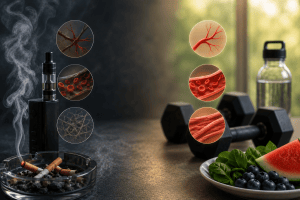
Most men thinking about girth enhancement focus on what happens in the appointment — the procedure itself, the timeline, the outcome. What happens in the weeks before and after matters just as much. Smoking and vaping are among the most clinically significant lifestyle factors that can alter how the body responds to hyaluronic acid filler treatment and how well the result holds over time.
Why Circulation Matters for Filler Results
Hyaluronic acid filler doesn’t just sit in tissue passively — it integrates with the surrounding environment over time through a process that depends heavily on adequate tissue perfusion. The filler needs blood flow to the treatment area to support the cellular processes that allow it to settle, maintain volume consistency, and avoid migration or uneven distribution.
Nicotine — whether delivered by cigarettes, cigars, pipes, or electronic vaporizers — is a potent vasoconstrictor. It causes the blood vessels that supply peripheral tissues to narrow, reducing blood flow to the capillary beds in the treatment area. This is not a minor or theoretical effect. Nicotine’s vasoconstriction is measurable within minutes of exposure and can persist for an extended period afterward. For a tissue that has just received filler and is in the process of integration, restricted blood flow to the area is a direct interference with the conditions that support a good outcome.
The penile tissue specifically — where girth enhancement filler is placed — is supplied by a dense network of small arteries and capillaries. That vascular density is part of what makes the treatment possible. It’s also part of what makes nicotine’s vasoconstrictive effects particularly relevant in this context compared to other body areas where filler is used.
“The treatment is the beginning of the process, not the end of it. What the tissue environment looks like in the weeks following the procedure is what determines how that process concludes. Anything that restricts circulation to the area during that window is working against the outcome.”
Nicotine’s Effect on Tissue Healing
The vasoconstrictive effect is the most immediate concern, but nicotine affects tissue healing through multiple overlapping mechanisms that compound each other in the post-procedure recovery period.
Reduced Oxygen Delivery
Carbon monoxide from combustible tobacco smoke binds to hemoglobin with an affinity roughly 200 times greater than oxygen — this is well-established biochemistry that appears in medical education at every level. The consequence is that smokers’ blood carries significantly less available oxygen to peripheral tissues regardless of how well the lungs are ventilating. Tissue repair and filler integration both depend on adequate oxygenation. Carbon monoxide’s interference with oxygen delivery is a direct mechanism by which smoking impairs healing in any post-procedure context, including after HA filler placement.
Electronic vaporizers don’t produce carbon monoxide in the same way combustible tobacco does, which is one reason vaping is sometimes presented as meaningfully safer in a surgical context. For nicotine delivery, the vasoconstrictive effect remains; and depending on the specific formulation of the vaporized product, additional chemical irritants may be present that affect inflammatory response in ways not yet fully characterized by the research available.
Impaired Collagen Synthesis
Nicotine and other tobacco smoke components inhibit the production and cross-linking of collagen — the structural protein that gives tissue integrity and supports the scaffold within which filler sits. This matters for girth enhancement specifically because the quality of the tissue environment that surrounds and supports the filler affects how evenly distributed and how stable the volume appears over time. Impaired collagen synthesis produces a tissue environment that is less supportive of the filler and potentially more prone to migration or uneven settling.
Heightened Inflammatory Response
Smoking alters the normal inflammatory cascade in ways that can either extend the post-procedure swelling period or produce a qualitatively different inflammatory response than providers see in non-smoking patients. Managing the inflammatory response after filler placement is part of what produces a predictable, even outcome — disruption to the normal cascade makes the outcome less predictable.
What “Before” and “After” Actually Means
The standard clinical recommendation for cosmetic filler procedures — and this is not unique to girth enhancement, it appears across aesthetic medicine for any procedure where vascularity and healing matter — is to stop smoking at least two weeks before the procedure and to avoid smoking through the initial recovery period, typically defined as a minimum of two weeks post-procedure.
Two weeks before the procedure is the minimum. Some providers and some procedure types recommend four to six weeks of cessation before a procedure for the most complete restoration of baseline tissue perfusion. The reasoning is that nicotine’s effects on circulation, while acute in their immediate impact, have cumulative effects on baseline vascular health that don’t fully reverse in 24 or 48 hours of abstinence. Two weeks without nicotine allows meaningful recovery of baseline vascular function — not complete reversal of long-term effects, but enough to support a better healing environment than active use produces.
After the procedure, the two-week minimum is the window during which the filler is most actively integrating and the tissue is most dependent on adequate blood flow to that process. Resuming smoking during this window reintroduces vasoconstriction and the other mechanisms at the moment when the tissue environment is most consequential to the final outcome.
Vaping: A Specific Note
Vaping occupies an interesting space in the smoking after fillers conversation because patients sometimes assume that avoiding combustible tobacco is the full answer. It isn’t. Electronic nicotine delivery systems — vapes, e-cigarettes, nicotine pods — still deliver nicotine and therefore still produce vasoconstriction through the same receptor mechanism as combustible tobacco. The vasoconstriction that impairs tissue perfusion in the procedure area is a function of nicotine itself, not specifically of the combustion process.
What vaping doesn’t produce to the same degree is carbon monoxide — the oxygen-displacing component of combustible tobacco smoke. This means vaping’s interference with healing is likely smaller in magnitude than combustible tobacco smoking, but it is not zero. The recommendation from providers who have addressed this specifically is typically to avoid nicotine in all delivery forms during the pre-procedure and post-procedure windows, not just to avoid combustible tobacco specifically.
Nicotine replacement products — patches, gum, lozenges — present the same vasoconstrictive issue from a healing standpoint, though often at lower peak nicotine concentrations than combustible or vaporized forms. If cessation during the procedure window requires pharmaceutical support, discussing this specifically with the provider — including what NRT products are in use and at what dose — gives them the information to advise appropriately.
The Conversation to Have With Your Provider
The most important practical step is disclosing smoking and vaping status honestly during the consultation process. This isn’t a disclosure that affects candidacy in most cases — it’s information that affects the pre-procedure preparation advice, the post-procedure instructions, and the timeline the provider sets for the patient. A provider who doesn’t know about active nicotine use can’t factor it into their recommendations, and a patient who receives standard post-procedure instructions without the nicotine-specific context is likely to miss the most consequential recovery variable they have direct control over.
Pre-procedure: stop smoking and vaping a minimum of two weeks before the procedure. Four to six weeks is preferable for patients who are heavy or long-term smokers.
Post-procedure: avoid smoking and vaping for a minimum of two weeks after the procedure — the filler integration window when tissue perfusion matters most.
Vaping vs. smoking: vaping still delivers nicotine and still produces vasoconstriction. It is not a safe alternative during the recovery window.
NRT products: nicotine patches, gum, and lozenges also carry vasoconstrictive effects. Discuss with your provider before using during the pre- or post-procedure period.
Disclosure: tell your provider about current smoking/vaping status during the consultation — it affects how they prepare you and what post-procedure instructions are most relevant.
For patients in the Argyle, Texas area who are evaluating whether their current lifestyle profile makes them a good candidate for the procedure, penis enhancement and girth enlargement in Argyle, Texas provides the consultation framework to address these questions directly. The girth enhancement procedure overview covers what the treatment involves and what the candidacy assessment considers. And for the full clinical picture of the clinic’s approach, the girth enlargement clinic is the right starting point for any patient beginning their research.
Frequently Asked Questions
How long should I stop smoking before girth enhancement?
The minimum recommendation across aesthetic filler procedures is two weeks of abstinence from nicotine before the procedure. For heavy or long-term smokers, four to six weeks is preferable to allow more complete restoration of baseline tissue perfusion and vascular function. The reasoning is that nicotine’s effects on circulation have both immediate (acute vasoconstriction, which resolves within hours of a dose) and cumulative (baseline vascular health) dimensions — two weeks addresses the cumulative dimension more meaningfully than shorter periods. Your provider may give you a specific timeline recommendation based on your smoking history and the specific procedure details; that individualized guidance takes precedence over the general figures.
Does vaping affect girth enhancement recovery the same way smoking does?
Vaping affects recovery through the same primary mechanism as combustible tobacco — nicotine delivery produces vasoconstriction that restricts blood flow to the treatment area. The magnitude of the effect may be somewhat smaller than combustible tobacco because vaping doesn’t produce carbon monoxide, which is the second major mechanism by which smoking impairs oxygen delivery to healing tissue. However, the vasoconstrictive effect is not eliminated by switching to vaping. The clinical recommendation is typically to avoid nicotine in all delivery forms — combustible, vaporized, and nicotine replacement products — during the pre- and post-procedure window, not only to avoid combustible tobacco.
What specifically does nicotine do to tissue during recovery?
Nicotine produces vasoconstriction — narrowing of the blood vessels that supply peripheral tissues — which reduces blood flow to the capillary beds in the treatment area. Reduced blood flow means reduced oxygen delivery, reduced nutrient delivery, and impaired removal of metabolic waste products from the tissue undergoing recovery. In practical terms, these effects slow the integration of the filler with surrounding tissue, may increase the risk of uneven distribution or migration, potentially extend the swelling period, and impair the collagen synthesis processes that support the structural environment the filler sits in. These effects are well-documented in wound healing and surgical recovery research across multiple procedure types; they apply specifically to aesthetic filler procedures including girth enhancement.
What if I smoke but still want good results from girth enhancement?
The most direct answer is that stopping smoking for the pre- and post-procedure windows — a minimum of two weeks before and two weeks after — gives you meaningful control over the most significant modifiable variable in your outcome. This is not a requirement for candidacy in most cases, but it is the recommendation that most directly supports a good result. Patients who are unwilling or unable to stop during the procedure window should disclose this to their provider so the provider can advise on adjusted expectations, potentially modified timing, and any additional monitoring that the smoking history warrants. The consultation is the right place for this conversation — not something to work around by not mentioning it.
Can I use a nicotine patch instead of smoking during recovery?
Nicotine patches, gum, and lozenges still deliver nicotine and still produce vasoconstriction, though often at lower peak concentrations than combustible or vaporized forms. They are not fully safe alternatives from a tissue perfusion standpoint during the recovery window. If nicotine dependence makes complete abstinence difficult and NRT use seems necessary, discussing this specifically with your provider — including which product, at what dose, and for how long — gives them the information to advise whether adjusted timing or additional post-procedure monitoring is appropriate. The goal is to give the provider accurate information about what’s actually in your system during recovery, not to find a form of nicotine that doesn’t need to be mentioned.
How long after girth enhancement should I avoid smoking?
The minimum post-procedure abstinence recommendation is two weeks following the procedure, which corresponds to the window of most active filler integration and the period when tissue perfusion matters most to the final result. Some providers recommend extending the abstinence period longer depending on individual healing assessment and the patient’s baseline vascular health. The two-week minimum is not the same as “two weeks and then resume without any effect” — the filler continues integrating and settling for up to six weeks post-procedure, and the tissue environment during that full window affects the outcome. The two weeks is the floor, not the full optimal window. Discuss your individual timeline with your provider at the post-procedure check-in.