
Changing penile size does not treat body dysmorphic disorder. A procedure may alter anatomy, but it cannot by itself address the preoccupation, checking, avoidance, or distress that defines the condition.
If you are researching penis enlargement because body dysmorphia or relentless size anxiety drives the decision, the first question is not which procedure to choose. It is whether a physical change can resolve the problem you want solved. This guide explains when it may not, what should prompt a pause, and what a responsible assessment should include.
Key takeaway
- Penis enlargement is not an evidence-based treatment for body dysmorphic disorder.
- Persistent checking, comparison, reassurance seeking, avoidance, or distress deserves qualified assessment before any cosmetic decision.
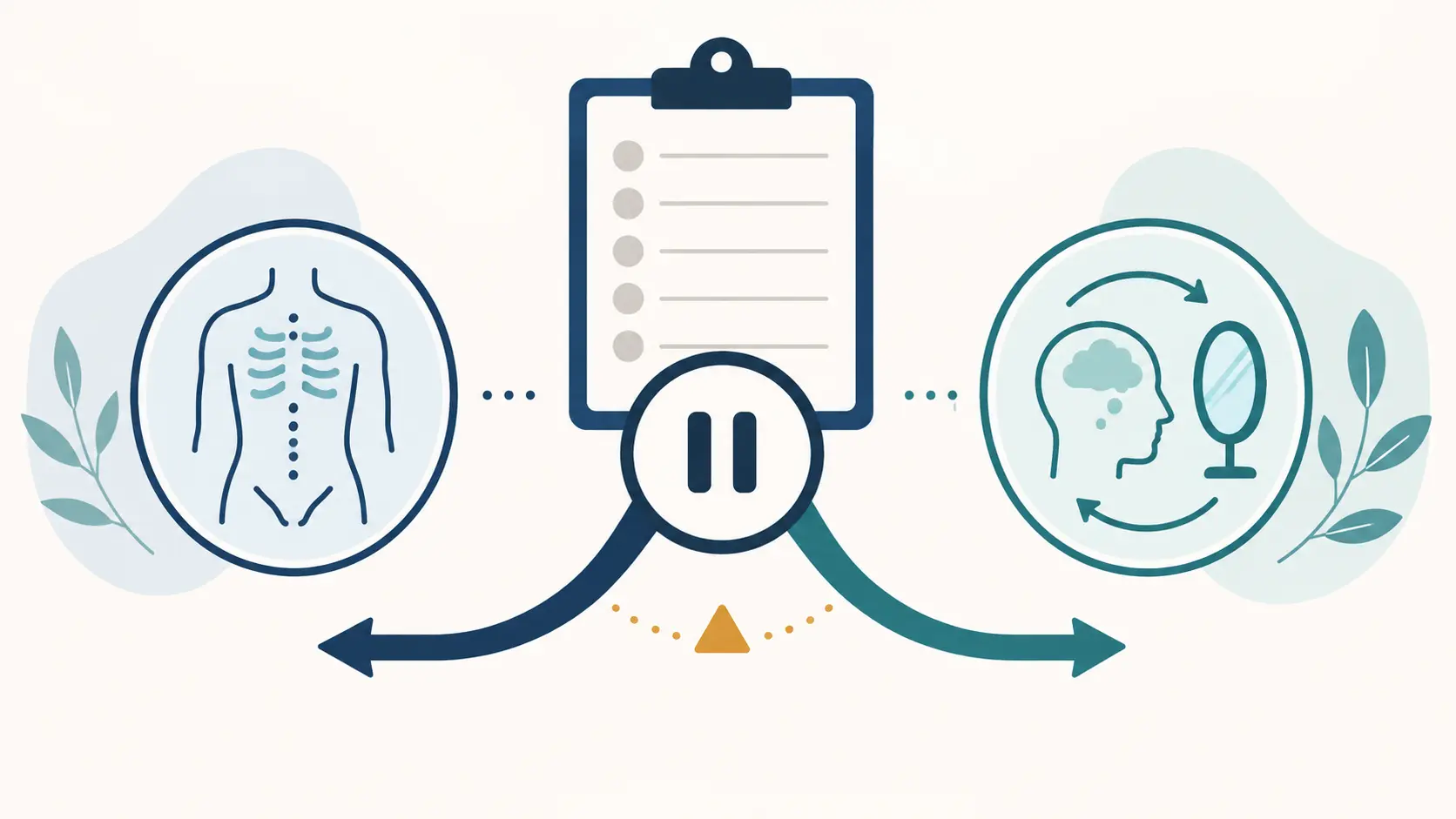
- Pausing does not dismiss the concern. It separates an anatomical question from a body-image condition that requires different care.
Use the pause-before-proceeding checklist before comparing procedures or providers.
What Is Penile Dysmorphic Disorder?
Body dysmorphic disorder, or BDD, involves a distressing or impairing preoccupation with an appearance flaw that others cannot see or consider slight. It also drives repeated checking, comparing, hiding, measuring, or reassurance seeking.
Penile dysmorphic disorder, or PDD, is shorthand for BDD focused on penile size or shape. The European Association of Urology guideline notes that PDD is not a separate diagnosis in the Diagnostic and Statistical Manual of Mental Disorders. Some searches use penile dysmorphic syndrome, but clinical copy should use BDD or PDD.
Concern about size does not automatically mean BDD. The distinction depends on the pattern and its effect on daily life.
| Type of concern | What may distinguish it |
| Ordinary dissatisfaction | The concern does not control daily decisions or cause major impairment. |
| Small penis anxiety | Anxiety focuses on a normal-sized penis without necessarily meeting BDD criteria. |
| Possible BDD or PDD | Preoccupation and repeated behavior cause distress or interfere with daily life. |
| Anatomical or functional condition | A clinician identifies a physical problem that needs medical assessment. |
This table cannot diagnose you. For broader context, review the penis size anxiety and body-image guide.
Can Penis Enlargement Cure Body Dysmorphia?
Penis enlargement does not cure BDD. The procedure and the disorder act on different targets.
An enhancement procedure changes tissue, contour, or visible dimensions. BDD treatment addresses the preoccupation, the meaning attached to the perceived flaw, repetitive checking or reassurance, avoidance, and impaired functioning. A physical change cannot replace that work.
The American Psychiatric Association warns that cosmetic treatment is almost never helpful for BDD and can make appearance concerns worse. A critical review of cosmetic-treatment outcomes also found that most people with BDD had poor outcomes after cosmetic intervention, although the available studies could not predict the response of every individual.
This does not mean that every man considering enhancement has BDD. It also does not mean that no person can feel satisfied after a physical procedure. The point is narrower: a technically acceptable result does not assure relief from shame, comparison, checking, or the belief that one more change is necessary.
Guidelines instead support BDD-focused psychological care. The NICE treatment guideline recommends cognitive behavioral therapy that addresses BDD features, including exposure and response prevention. Depending on severity and individual needs, a qualified prescriber may also consider medication. Those decisions require a clinical assessment, not an online checklist.
When Is Enhancement Unlikely to Resolve the Underlying Concern?
Enhancement becomes a poor first step when the hoped-for result reaches far beyond anatomy. Statements such as “I will finally be acceptable,” “my relationship will be fixed,” or “I will stop thinking about size” place a psychological burden on a physical procedure.
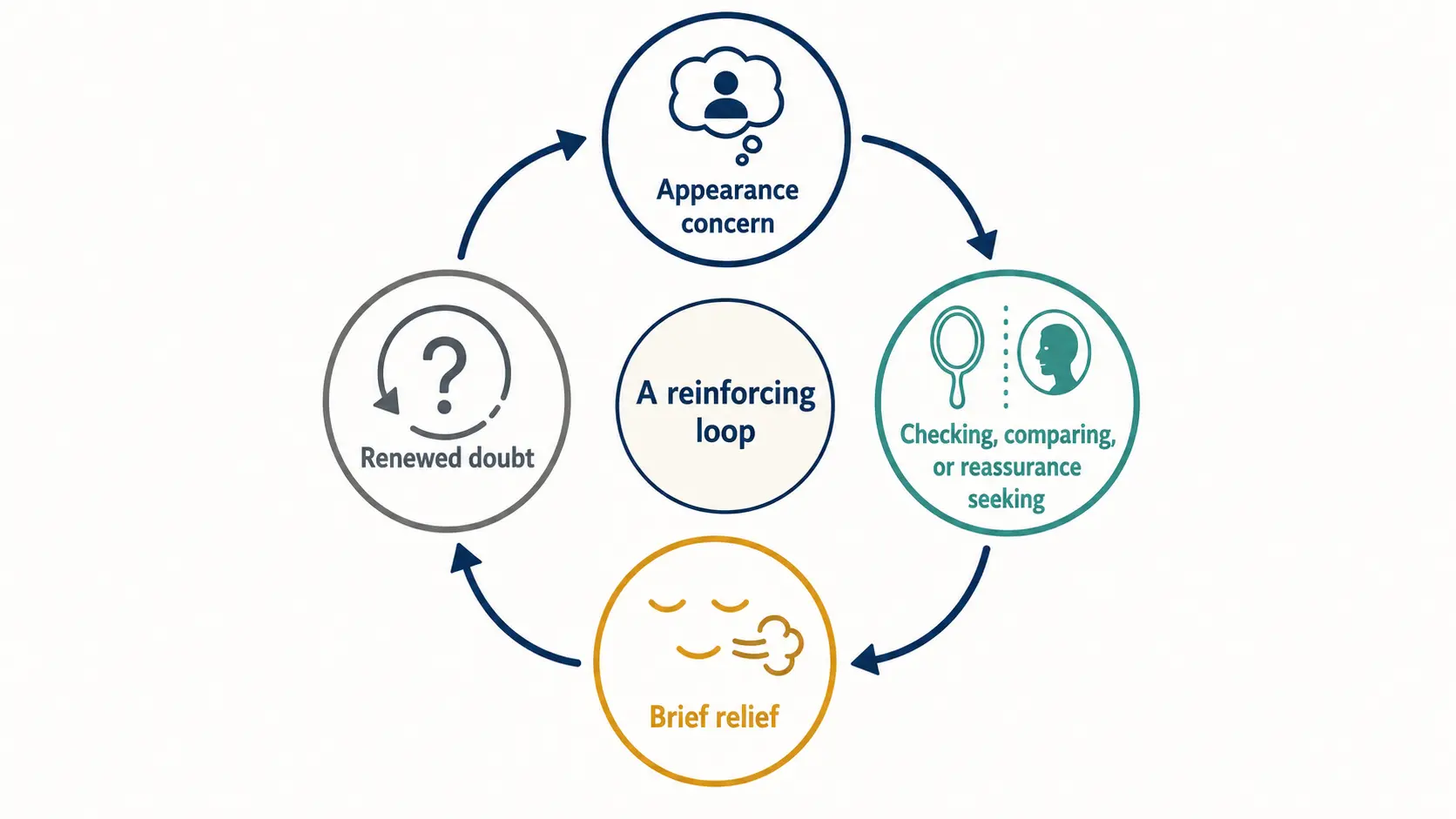
Repeated behavior matters as much as the stated goal. The concern deserves further assessment when measuring, mirror checking, comparing online, hiding the body, or asking for reassurance takes up substantial time. The same applies when reassurance brings only brief relief, the target size keeps changing, or one consultation leads immediately to another.
Avoidance also matters. Some men stop dating, avoid intimacy, change how they dress, or withdraw from ordinary activities because they fear judgment. Read more about the connection between male confidence and girth perception and how body concerns can affect relationships and partner dynamics.
No single behavior proves BDD. A pattern of persistent distress, repetitive behavior, and impaired functioning is a reason to pause and obtain qualified assessment.
Pause Before Proceeding: A Do-Not-Proceed Reflection Checklist
Use Yes, Unsure, or No for each statement. Do not calculate a score. One answer cannot establish a diagnosis or determine whether a procedure is appropriate.
- I expect a size change to repair my self-worth, masculinity, relationship, or sexual confidence by itself.
- I repeatedly measure, check mirrors, compare photographs, search online, conceal my body, or ask other people for reassurance.
- Reassurance helps briefly, but the concern soon returns at the same intensity.
- My target size or preferred result keeps increasing or changing.
- Thoughts about size interfere with intimacy, work, study, sleep, social contact, or daily routines.
- I have consulted several providers or kept searching after a clinician advised me to delay or reconsider treatment.
- I find it difficult to tolerate the possibility that a responsible clinician may decline to perform a procedure.
- I believe a technically successful procedure must remove all distress about my body.
A Yes or Unsure answer does not prove BDD. It identifies a point that deserves a slower discussion. The concern becomes more pressing when several items feel persistent, hard to control, or disruptive.
Do not use this checklist to argue yourself into or out of treatment. Bring the answers to a qualified mental health professional, urologist, or both, depending on the concern. A clinician can ask what the checklist cannot: how long the pattern has lasted, what maintains it, whether an anatomical problem exists, and how much the concern affects your life.
Use the Consultation and Provider-Verification Checklist before contacting any clinic.
What Should a Proper Assessment Include Before Any Procedure?
A responsible assessment should separate four questions: what is happening physically, what you expect emotionally, how the concern affects your life, and whether a procedure matches the actual problem.
| Assessment area | Why it matters |
| Medical and sexual history | Identifies symptoms, past procedures, medications, injuries, and relevant conditions. |
| Appropriate physical examination | Distinguishes a perceived concern from an anatomical or functional condition. |
| Goals and expected outcomes | Separates a physical goal from hopes about identity, relationships, or self-worth. |
| Body-image symptoms | Assesses checking, comparison, concealment, reassurance, avoidance, and time spent preoccupied. |
| Daily functioning | Shows whether the concern disrupts work, school, intimacy, relationships, or social life. |
| Previous treatment | Tests whether dissatisfaction has persisted despite earlier cosmetic treatment. |
The EAU recommends screening men with a normal-sized penis who report short-size concerns for BDD and referring suspected cases for mental health counseling. Screening questionnaires can support that process. The Cosmetic Procedure Screening Scale for PDD is one penile-focused example, but it does not replace diagnosis.
Psychological assessment asks whether the proposed treatment matches the source of the distress. Before a consultation, prepare questions about candidacy, evidence, risks, and follow-up.
What Do We Know, and What Remains Uncertain?
Good decisions require both evidence and visible limits. Penile-specific research remains narrower than the broader literature on BDD and cosmetic treatment.
| What the evidence supports | What remains uncertain |
| BDD involves preoccupation, repetitive behavior, distress, or impairment, not simple dissatisfaction alone. | No online checklist can determine whether one person has BDD. |
| Cosmetic intervention is not an evidence-based treatment for BDD. | Research cannot predict with certainty how one individual will respond to a specific penile procedure. |
| Qualified screening and assessment matter before an invasive decision. | Penile-specific outcome studies remain limited, and study methods differ. |
| BDD-focused CBT has guideline support. A prescriber may consider medication when clinically appropriate. | The right order of mental health, psychosexual, and urologic care depends on the person and the findings. |
A study of men seeking penile girth augmentation found higher PDD symptoms and lower body-image-related quality of life than non-clinical norms. A subset met diagnostic criteria for BDD. The sample was small, so do not apply the findings to every man seeking enhancement. Read the study abstract and limitations.
What Is the Safest Next Step if the Concern Feels Hard to Control?
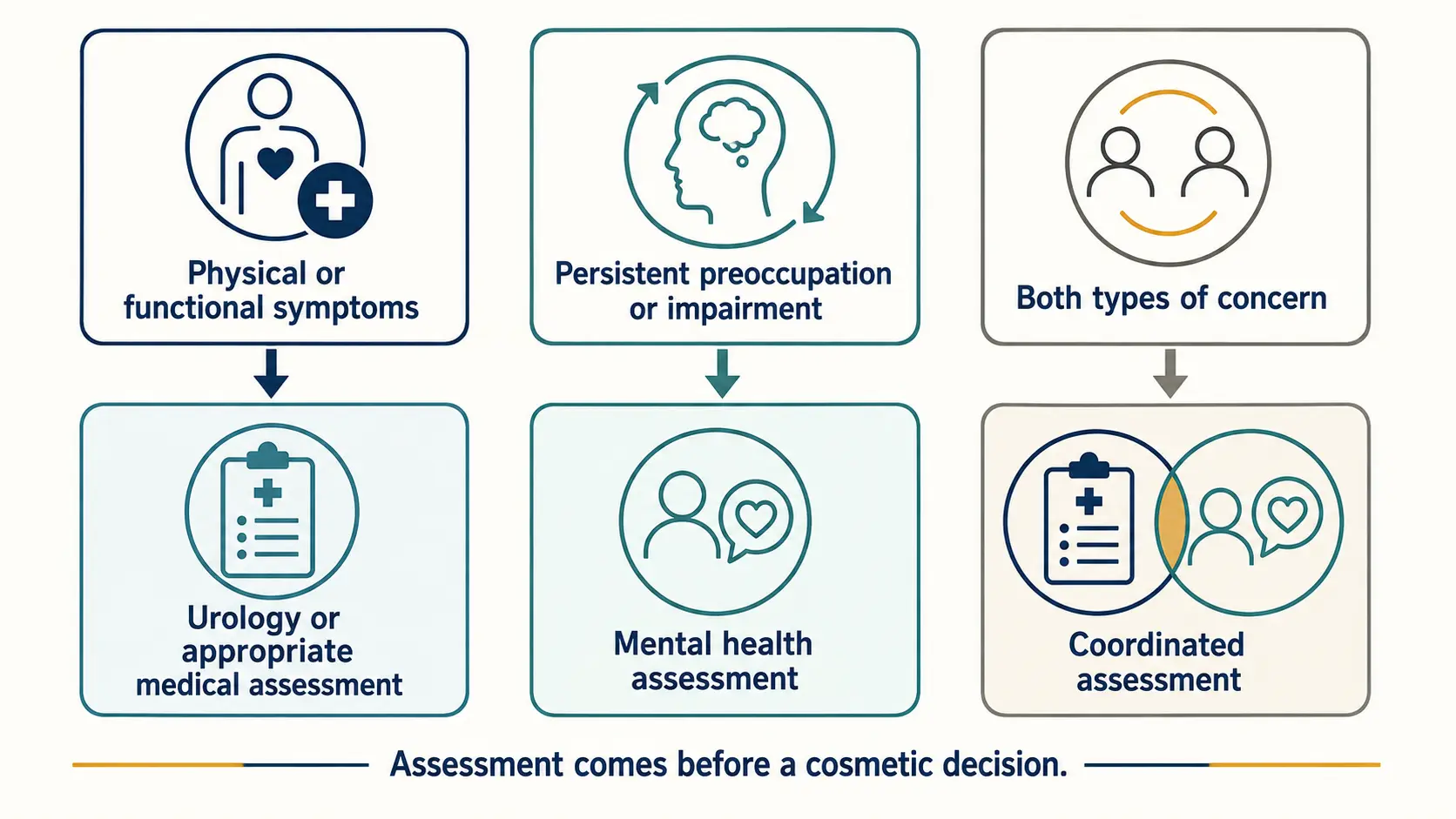
Choose the next step according to the problem that needs assessment.
- Physical or functional symptoms: See an appropriate medical professional or urologist. Pain, curvature, acquired shortening, urinary problems, erectile concerns, or suspected anatomical changes need clinical evaluation.
- Persistent preoccupation or impairment: Seek a mental health professional with BDD or body-image expertise. The goal is to assess the thought and behavior pattern, not obtain another measurement.
- Continued interest after assessment: Verify the provider, procedure, evidence, limits, risks, alternatives, consent, and follow-up. Ask when the provider would advise against treatment.
A recommendation to pause is not dismissal. It protects the possibility that the first treatment decision may otherwise leave the main source of distress untouched.
The difference between girth and length concerns can clarify the physical question. Use the penis size anxiety guide for the body-image question.
Consultation and Provider-Verification Checklist
Before choosing a clinic, ask:
- Who will assess me, and how can I verify that person’s license and scope?
- Which procedure or product does the provider propose, and what is its regulatory status for this use?
- What evidence supports the claimed outcome for people like me?
- Which risks, limitations, alternatives, and follow-up needs apply?
- How does the provider assess expectations and possible BDD?
- Under what circumstances would the provider delay or decline treatment?
- How will the clinic protect intimate health information and patient images?
- Who handles complications, and what happens if I remain dissatisfied?
Download the Consultation and Provider-Verification Checklist. Save it before comparing clinics, images, prices, or procedures.
Frequently Asked Questions
What is penile dysmorphic disorder?
Penile dysmorphic disorder is shorthand for BDD focused on penile size or shape. It may involve persistent preoccupation, repetitive behavior, distress, or impaired functioning.
Can penis enlargement cure body dysmorphia?
Penis enlargement does not cure BDD. A procedure changes anatomy, while BDD-focused care addresses preoccupation, repetitive behavior, avoidance, and impairment.
When should I pause before considering penis enlargement?
Pause when reassurance never lasts, goals keep changing, or thoughts about size disrupt intimacy or daily life. These patterns warrant assessment before a procedure.
Who can assess possible penile dysmorphic disorder?
A mental health professional should assess suspected BDD. A urologist or another appropriate clinician can assess anatomical or functional concerns. Some people need both perspectives.
What happens during a body-image or BDD assessment?
The clinician asks about appearance concerns, repetitive behaviors, avoidance, distress, and daily impairment. A validated questionnaire may support screening, but diagnosis requires clinical judgment.
What are the risks of proceeding when a provider suspects BDD?
The procedure may leave the preoccupation unchanged, bring brief relief, or shift attention to another perceived flaw. Complications can add further distress.
Does worrying about penis size automatically mean I have BDD?
Worry alone does not establish BDD. Clinicians look for preoccupation, repetitive behavior, distress, or impairment, then consider other explanations.
How is penile dysmorphic disorder different from small penis anxiety?
Small penis anxiety describes excessive worry about a normal-sized penis. PDD refers to BDD focused on penile appearance and includes the broader BDD symptom pattern.
Can concern about size persist or shift after a cosmetic procedure?
It can. Brief relief may give way to renewed dissatisfaction, concern about the same area, or focus on another perceived flaw. Individual outcomes remain difficult to predict.
Is a psychological assessment worth doing before enhancement?
It can prevent a mismatch between the procedure and the source of distress. Assessment may also identify BDD, severe anxiety, unrealistic expectations, or relationship pressure.
How should a responsible provider respond when they suspect BDD?
A responsible provider should slow the process, avoid promising emotional change, assess within professional scope, and refer for mental health evaluation when appropriate. Treatment should not replace screening.
What should I do before booking a penis-enlargement procedure?
Separate physical goals from emotional expectations. Complete the reflection checklist, seek assessment, verify the provider and treatment, and review risks, alternatives, consent, privacy, and follow-up.
References
- European Association of Urology: Penile Size Abnormalities and Dysmorphophobia
- NICE: Obsessive-Compulsive Disorder and Body Dysmorphic Disorder Treatment Recommendations
- American Psychiatric Association: Obsessive-Compulsive and Related Disorders
- Bowyer et al.: Cosmetic Treatment Outcomes in Body Dysmorphic Disorder
- Veale et al.: Penile Dysmorphic Disorder Screening Scale
- Sharp et al.: Men Seeking Penile Girth Augmentation