
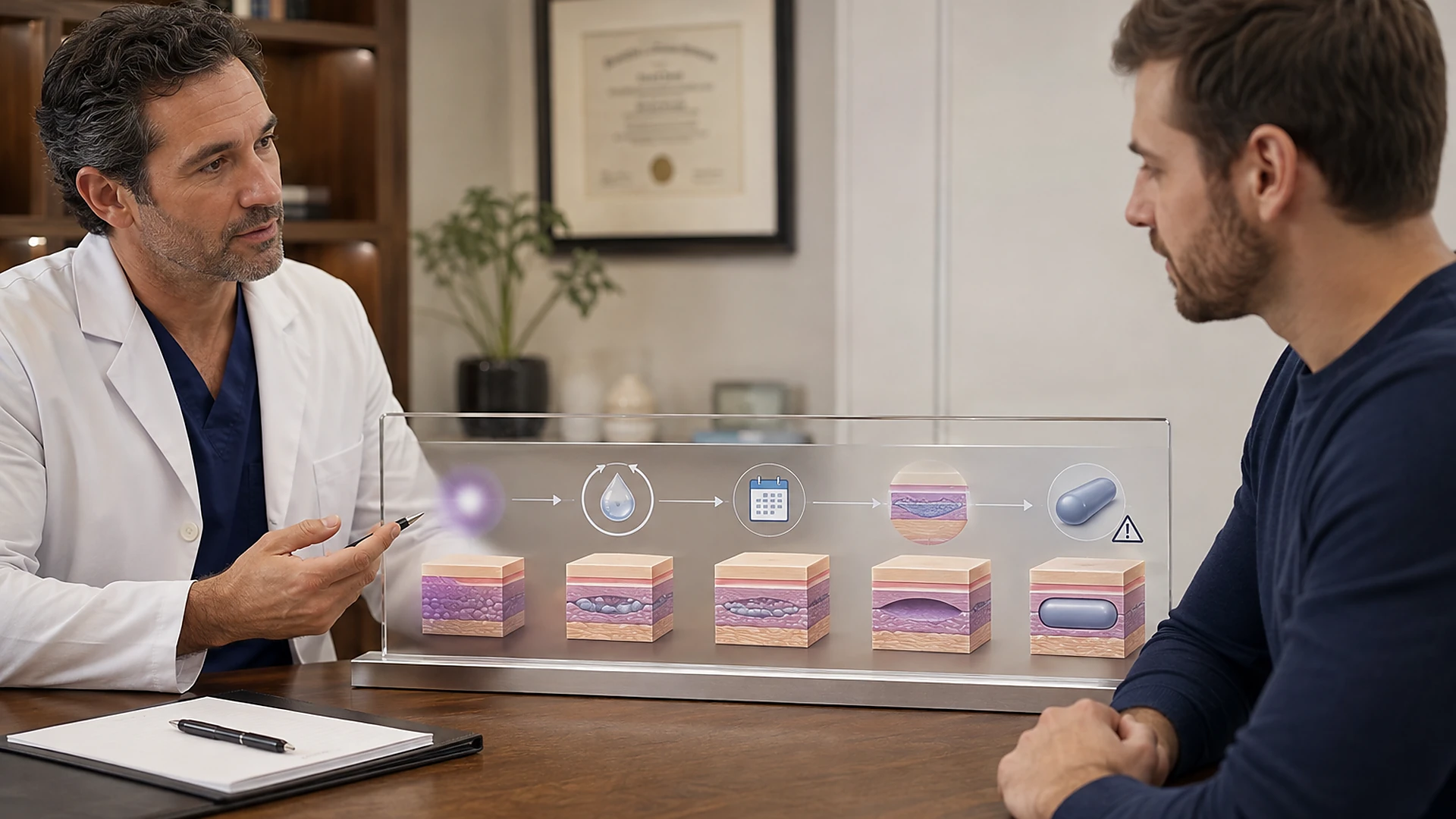
The word “permanent” can make very different treatments sound more alike than they are. Some methods create a brief change, some require maintenance, and others leave material or anatomical changes that can be difficult to reverse. A useful comparison of permanent penis enlargement must look beyond duration and consider evidence, risk, reversibility, and cost.
This guide compares the main penis enlargement options on those terms. It also separates length from girth because the same procedure rarely addresses both in the same way.
Key takeaway: A result can last a long time without being permanent. A permanent material or surgical change can also remain difficult to correct if the result causes a problem. The longest-lasting option is not automatically the right one.
Which Penis Enlargement Results Are Permanent?
Methods that place nonabsorbable material or alter anatomy through surgery may create persistent changes. That does not mean the size increase will remain identical for life. Aging, weight changes, scar formation, tissue response, complications, and later revision can all affect the result.
Hyaluronic acid, or HA, fillers fall into a different category. The body gradually absorbs HA, so the effect generally decreases over time and may need maintenance. Penile traction may produce a modest length change with consistent use, but the evidence remains limited and does not support girth enlargement.
The European Association of Urology states that evidence remains limited across many penile augmentation techniques. It recommends careful assessment, realistic expectations, and detailed counselling about potential benefits and complications.
Temporary, Semi-Permanent, and Permanent Are Not Fixed Medical Categories
Clinics and product pages often use these labels as shorthand. They make more sense when each label connects to a biological mechanism and a maintenance plan.
Temporary effects
A temporary method changes appearance only while the method affects blood flow, swelling, or tissue position. A vacuum device, for example, can create temporary fullness. The EAU does not consider vacuum devices effective for penile lengthening.
Pills, lotions, and manual exercises do not have established evidence for permanent enlargement. A short-term change in fullness or erection quality also does not prove new tissue growth.
Maintenance-dependent or semi-permanent results
Some fillers add volume that the body gradually absorbs. The visible change may last beyond the recovery period, but it can diminish and require another treatment. Individual metabolism, the filler, the amount used, placement, and follow-up can affect how the result changes.
“Semi-permanent” should therefore mean maintenance-dependent, not guaranteed for a fixed number of years. A provider should explain what usually changes over time and what maintenance may involve.
Persistent or difficult-to-reverse changes
Nonabsorbable fillers and surgery can create changes that remain after healing. These options may also require surgical removal, revision, or treatment of scar tissue if a complication develops.
The U.S. Food and Drug Administration notes that permanent fillers can be difficult or impossible to remove completely. Persistence describes the material or anatomical change. It does not guarantee appearance, function, sensation, or satisfaction.
Permanent Penis Enlargement Methods Compared
The most useful comparison asks what creates the change and what happens if the result fades, shifts, or causes a problem. Readers who want a closer look at injectable materials can also compare girth filler types and their behavior.
| Method | Main goal | Durability | Maintenance | Reversibility | Main limitation |
| Vacuum device | Temporary fullness or erectile support | Short-lived | Repeated use | Effect subsides | Does not establish permanent enlargement |
| Penile traction | Length | Possible change after months of consistent use | Continued use may form part of a clinical plan | No implanted material | Limited evidence, demanding schedule, and no girth gain |
| HA filler | Girth | Temporary to maintenance-dependent | Repeat treatment may be needed | A clinician may use hyaluronidase to reduce HA | Results and maintenance vary; reversal has its own risks |
| PLA or other biostimulatory filler | Girth | Longer-lasting but variable | May require later treatment | Not readily dissolved like HA | Less control if the result becomes uneven or unwanted |
| PMMA or another nonabsorbable filler | Girth | Persistent | Touch-ups or complication care may still occur | Difficult to remove | Long-term complication and revision burden |
| Fat transfer | Girth | Variable because the body may absorb part of the transferred fat | Additional treatment may be needed | Surgical correction may be required | Unpredictable retention, contour, and long-term evidence |
| Suspensory ligament release | Visible flaccid length | Anatomical change may persist | Postoperative care may include traction | Surgical revision may be difficult | Does not reliably increase erect length and can affect stability |
| Grafts or subcutaneous implants | Girth or visible size | Persistent | Follow-up and possible revision | Removal requires surgery | Limited long-term evidence and procedure-specific complications |
Durability and reversibility timeline
- Effect lasts only during use: vacuum-related fullness and similar short-lived changes.
- Effect may persist after repeated use: traction may produce modest length change, but results depend on adherence and evidence remains limited.
- Result fades and may need maintenance: HA and other absorbable fillers.
- Result lasts longer but offers less direct reversal: biostimulatory fillers and variable fat transfer results.
- Material or anatomical change persists: nonabsorbable fillers, implants, and surgery, with a greater potential need for complex revision.
Lasting Length and Lasting Girth Are Different Questions
A search for how to permanently increase penile length should not lead to a girth-filler page. Fillers add volume around the shaft. They do not lengthen the erectile tissue.
What may affect length
Penile traction applies controlled tension over time. The EAU considers traction a possible conservative option for length, but it gives this recommendation a weak strength rating. The guideline also states that traction does not increase girth.
Suspensory ligament release changes how much of the penis appears outside the body while flaccid. It does not reliably increase erect length. Surgery may also introduce infection, pain, scarring, instability, or dissatisfaction.
What may affect girth
Fillers, fat transfer, grafts, and subcutaneous implants target circumference rather than erectile length. Each method has a different pattern of absorption, tissue response, maintenance, and reversibility.
Before comparing procedures, decide whether the concern involves length, girth, visible flaccid size, or erection quality. The distinction prevents a person from choosing a procedure that cannot address the actual goal. The separate guide to girth versus length explains this difference in more detail.
What the Evidence Supports and What Remains Uncertain
Professional guidance does not identify one permanent enlargement method as the clear choice for every patient. The evidence includes small studies, different measurement methods, limited follow-up, and selected patient groups. These limitations make direct comparisons difficult.
The Sexual Medicine Society of North America describes HA and PLA fillers as temporary options for girth and calls for more safety and effectiveness research. It discourages permanent injections such as silicone and paraffin because they can cause severe long-term complications. The society also limits its support for some surgical techniques to carefully selected, informed patients or research settings.
The evidence supports several practical conclusions:
- Traction may produce a modest length change, but it demands consistent use and does not increase girth.
- HA and PLA fillers can add girth temporarily, but results decrease over time.
- Nonabsorbable materials can persist, but persistence makes removal and complication care harder.
- Surgery can change anatomy or visible flaccid length, but each operation carries specific limits and risks.
- No method removes the need for realistic expectations and informed consent.
Long-term satisfaction remains harder to predict than short-term size change. A technically measurable result may still feel wrong if it does not match the patient’s expectations, appearance, sensation, or function.
Permanent Penis Enlargement Risks Rise as Reversibility Falls
Every medical procedure carries risk. With penile enhancement, the consequences can include swelling, infection, asymmetry, nodules, migration, fibrosis, contour changes, altered sensation, scarring, tissue injury, or dissatisfaction. Some problems resolve with conservative care. Others require injections, drainage, removal, or reconstructive surgery.
The FDA explains that removing filler may require injections, surgery, or another intervention. It also warns that removal can become difficult or impossible with permanent materials. The FDA dermal filler guidance lists each approved anatomical use. The penis does not appear among those approved sites, so penile filler treatment represents off-label use in the United States.
An FDA-approved filler product is not automatically FDA-approved for penile enhancement. A responsible consultation should make that distinction clear and discuss the injector’s training, consent process, complication plan, and follow-up.
Never inject silicone, paraffin, petroleum jelly, or a product bought online. Both the EAU and SMSNA warn against permanent foreign-material injections because they can cause serious tissue damage and may require complex removal.
How Much Does Penile Enlargement Cost?
The answer depends on the method, provider, location, amount of product, number of sessions, anesthesia, facility fees, follow-up, maintenance, and possible revision. The first bill does not always represent the total cost.
Temporary and maintenance-based treatments may spread costs across repeat visits. Surgical procedures may carry higher initial costs plus anesthesia, recovery, follow-up, or revision. A difficult-to-reverse complication can add medical costs that no advertised package includes.
The P Clinic currently lists a Starter package at $7,500 and a Platinum package at $12,000 for its non-surgical penis enlargement service. The clinic also lists financing through CareCredit and Cherry. Published prices and package details can change, so confirm current inclusions during consultation.
Compare total cost across the expected maintenance period. Ask what the quoted price includes, what follow-up costs extra, and what happens if you need correction or reversal.
How to Choose the Right Level of Durability
Someone searching how to permanently enlarge the penis may focus on duration first. Start with the goal and acceptable downside instead.
Use these questions to compare options:
- Do you want more length, more girth, a different flaccid appearance, or better erection quality?
- Would you accept repeat maintenance to preserve greater reversibility?
- What change would you consider meaningful, and is that expectation realistic?
- How much recovery, uncertainty, and complication risk can you accept?
- Who will manage follow-up, reversal, or revision if the result changes?
- What will the method cost over several years, not only on treatment day?
Bring these questions to a consultation. The guide to questions to ask before girth enhancement can help you compare providers on the same terms.
Compare methods by evidence, reversibility, risk, and total cost before choosing a procedure.
When Professional Assessment Matters Before Enhancement
A clinician should assess more than the requested size change. Medical and sexual history, stretched and erect measurements, penile shape, erectile function, previous procedures, and expectations can change the recommendation.
Assessment matters when a person has pain, curvature, erectile changes, a buried penis, previous injections, prior penile surgery, or marked distress about normal anatomy. The EAU recommends screening for body dysmorphic disorder when a patient with normal measurements requests augmentation. It also recommends mental health referral when screening raises concern.
That referral does not dismiss the person’s goals. It helps identify whether a procedure can address the concern or whether another form of care would offer more benefit. The girth-enhancement candidacy guide covers additional factors to discuss before treatment.
Where a Maintenance-Based, Reversible Approach May Fit
A person who values adjustability may prefer to discuss an absorbable filler rather than begin with a permanent material or surgery. HA does not offer a permanent result, but that limitation can also preserve options if goals or anatomy change.
The P Clinic focuses on private, appointment-based penis girth enhancement with HA filler. A consultation should cover the off-label nature of penile filler use, expected maintenance, possible side effects, aftercare, cost, and the clinic’s plan for managing complications.
This approach will not fit everyone. The choice should follow an individual assessment rather than a promise that one treatment works for every patient.
The Best Option Is Not Automatically the Most Permanent
Permanent penis enlargement is not one treatment with one predictable endpoint. It covers several methods with different goals, evidence, maintenance needs, and consequences if the result becomes unwanted.
Choose the level of reversibility you can accept before choosing the method. Then compare the evidence, total cost, provider experience, and complication plan. If a maintenance-based girth option matches those priorities, request a private consultation to review candidacy and current treatment details.
Frequently Asked Questions
What does permanent penis enlargement mean?
It usually refers to a material or anatomical change that remains after treatment. The term does not guarantee that size, appearance, sensation, or satisfaction will remain unchanged throughout life.
Which penis enlargement results are permanent?
Nonabsorbable fillers and some surgical changes may persist. They can also be difficult to reverse. HA filler requires maintenance, while traction may produce limited length change after prolonged use.
Is it possible to enlarge penis size?
Some medical approaches can change measured length, girth, or visible flaccid size. The amount, durability, evidence, and risk differ by method, and many marketed pills or exercises lack established evidence.
Who should assess someone before penile enhancement?
A qualified clinician with relevant anatomical and procedural knowledge should review medical history, sexual function, measurements, goals, and risk factors. Psychological screening may also matter when distress appears disproportionate to objective findings.
What happens during a penis enlargement procedure?
The process depends on the method. A legitimate medical pathway should include assessment, informed consent, discussion of alternatives, treatment by a qualified clinician, aftercare instructions, follow-up, and a complication plan.
What are the risks of permanent enlargement methods?
Possible risks include infection, asymmetry, nodules, fibrosis, altered sensation, scarring, tissue damage, dissatisfaction, and revision. Permanent materials can make correction or removal more difficult.
Are penis filler results permanent?
HA filler results are not permanent and may require maintenance. Biostimulatory or nonabsorbable fillers can last longer, but they offer less control if the result becomes uneven or unwanted.
What is penile enlargement surgery?
The term covers procedures that alter visible length, girth, or surrounding anatomy. Different operations have different goals, and some change flaccid appearance without reliably increasing erect length.
How to permanently increase penile length?
No simple method guarantees permanent length gain. Traction may produce a modest change with prolonged use, while lengthening surgery has specific limits and risks that require specialist assessment.
How much does penile enlargement cost?
Cost varies by method, sessions, facility, maintenance, and follow-up. The P Clinic currently lists non-surgical packages at $7,500 and $12,000, subject to confirmation before treatment.
Is a reversible option better for some people?
It can be. Someone who values adjustability or has not had enhancement before may prefer a maintenance-based HA approach, provided a clinician confirms candidacy and explains its risks.
What should I do before booking a consultation?
Define whether your goal involves length, girth, appearance, or function. Bring questions about evidence, off-label use, maintenance, total cost, aftercare, complications, and the provider’s plan if the result needs correction.