
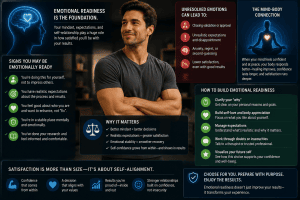
The procedure matters. The provider matters. But the emotional state you bring to the whole experience shapes the outcome just as much as either of those — sometimes more.
Patient satisfaction research across elective aesthetic procedures consistently shows that emotional readiness — the alignment between internal expectations, motivations, and psychological state — is one of the strongest predictors of post-procedure satisfaction. That finding holds specifically for male enhancement procedures, where the motivations are often more complex and the privacy of the experience means men have fewer external reality checks to draw on.
This post looks at what emotional readiness for girth enhancement actually means, why it matters, and what genuine preparation looks like — not as a barrier between a man and a decision he’s already made, but as a framework for arriving at that decision in a way that leads to lasting satisfaction.
Why Emotional State Influences Outcomes in Elective Procedures
The connection between psychological readiness and procedure satisfaction is well-documented in the cosmetic medicine literature. A person’s pre-procedure emotional state affects how they experience the consultation, how they interpret results during recovery (before the final outcome is visible), how they respond to the inevitable variation between expected and actual results, and how satisfied they are at the six-month and one-year marks.
For girth enhancement specifically, a few emotional dynamics come up with particular frequency in the patient satisfaction literature and in practitioner observations.
Motivation Source Matters
Men who pursue girth enhancement primarily for themselves — because they want to feel more confident in intimate settings, because the self-consciousness has been a long-standing source of distress, because they’ve made a considered decision that this would improve their quality of life — tend to report higher satisfaction than men whose primary motivation is external. Pursuing a procedure to please a partner, to compete with perceived standards, or in response to criticism tends to produce less stable satisfaction, because the underlying concern isn’t fully addressed by the physical change.
This isn’t a moral judgment. It’s a practical observation about what produces lasting positive outcomes. A decision made for internally grounded reasons lands differently than one made in response to external pressure — and that difference shows up in patient satisfaction data over time.
Unrealistic Expectations Are the Most Common Source of Dissatisfaction
The single most consistent predictor of post-procedure dissatisfaction in elective aesthetic medicine is expectation mismatch — a gap between what the patient anticipated and what the procedure delivered. For girth enhancement, this often shows up in two specific ways: overestimation of the degree of change possible from a single treatment, and underestimation of the natural variation in how results develop over the weeks following the procedure.
Patients with carefully calibrated, realistic expectations are far less likely to experience this mismatch. The calibration work happens partly in the consultation — a good provider spends real time on expectations management — but it also requires the patient to arrive having done their own honest thinking about what they’re hoping for and whether that hope is grounded in realistic outcomes.
“Satisfaction with any aesthetic procedure is partly about the result and partly about whether the result matches the version you were hoping for. The closer those two things are, the better the outcome feels.”
The Role of Body Image in Girth Enhancement Readiness
Body image readiness is a specific dimension of emotional preparation that deserves its own attention. Body image — the internal perception of one’s own body and its relationship to feelings of adequacy, attractiveness, and self-worth — is complex and doesn’t change in a linear way in response to physical changes.
For men with body image concerns centered on genital size or proportion, girth enhancement can be a meaningful, positive intervention. For men whose body image concerns are more generalized — where size is one of several things they find inadequate about their physical presentation — girth enhancement addresses only one element of a broader pattern that the procedure alone won’t resolve.
The distinction between these two situations matters for satisfaction outcomes. A man whose primary and specific concern is girth — who is otherwise comfortable in his body and confident in his sense of self — is in a different emotional starting point than one for whom girth is one item on a longer internal list of inadequacies. Both deserve respectful, non-judgmental care. But the expectations and the likely outcomes look different, and honest preparation means acknowledging that distinction.
When Body Dysmorphia Is a Factor
Body dysmorphic disorder (BDD) involves a preoccupation with perceived physical flaws that is disproportionate to objective observation and causes significant distress or functional impairment. BDD affecting the genitals — sometimes called penile dysmorphia — is specifically relevant in the context of enhancement procedures and requires careful clinical screening.
Men with BDD tend to remain dissatisfied after elective procedures because the underlying perceptual distortion isn’t addressed by physical change. Qualified providers screen for this during the consultation process, and patients who have their own concerns about whether their body image concerns are proportionate should raise those concerns openly in the consultation. This is not a reason to avoid pursuing a procedure — it’s a reason to pursue the right support alongside it.
Mental Preparation for Girth Enhancement: What It Actually Looks Like
Mental preparation for male enhancement isn’t a formal process with a checklist. It’s more about the quality of the internal conversation a man has with himself before committing to a procedure. A few specific areas are worth that attention.
Clarity on Motivation
Being able to answer — honestly, privately — why you want this, and whether that reason feels grounded and genuinely yours, is the most important preparation work. “I’ve been self-conscious about this for years and I want to change it” is different from “my partner made a comment” or “I saw something online and started worrying about comparison.” Both might lead to the same consultation, but only the first one tends to lead to enduring satisfaction with the outcome.
Realistic Outcome Visualization
Mental preparation includes imagining the realistic version of the outcome — not the best-case scenario, but the typical, well-documented range of results — and checking whether that version still feels worth pursuing. If the answer is yes, the motivation is grounded. If the answer is “maybe, but only if the results are at the high end,” that’s a signal that expectations need more calibration before the procedure is the right next step.
Emotional Stability at the Time of Decision
Elective procedures made during periods of acute emotional distress — following a breakup, during a period of significant life disruption, or at a low point in self-esteem — have worse satisfaction outcomes than the same procedures made from a more stable emotional baseline. This isn’t about waiting until everything in life is perfect. It’s about not making a permanent or semi-permanent body change from a place of acute emotional reactivity.
Confidence and Satisfaction: The Relationship Between Them
One of the genuine benefits of girth enhancement for the right patient is the confidence effect — the shift in how a man feels in intimate situations that follows a physical change he chose deliberately and feels good about. That confidence effect is real and well-reported by satisfied patients.
But it’s worth understanding the mechanism correctly. The confidence doesn’t come from the girth change itself — it comes from the combination of the physical change, the deliberate self-advocacy it represents, and the relief of no longer carrying the self-consciousness that preceded the procedure. Men who were already reasonably confident and sought enhancement as a specific improvement tend to experience this most clearly. Men who were hoping the procedure would resolve broader confidence or self-worth concerns tend to find that those concerns require different kinds of work.
Confidence and satisfaction after enhancement are real outcomes for the right patient with the right preparation. The preparation work described in this guide exists precisely to help ensure that the patient walking into the procedure room is in the best possible position to experience those outcomes.
The Consultation as an Emotional Checkpoint
A good consultation for girth enhancement does more than explain the procedure and take measurements. It creates space for the kind of honest conversation that helps both the provider and the patient understand whether the timing and motivation are right. Providers who ask about your goals, your history with this concern, and your expectations — and who listen carefully to the answers — are performing a clinical service that’s genuinely in your interest, not a bureaucratic hurdle.
If you find yourself in a consultation where the emotional and motivational dimensions of the decision aren’t being explored at all, that’s worth noticing. The best outcomes come from partnerships between patients and providers who both take the full picture seriously.
For men in the Houston area who want a consultation experience that takes both the clinical and emotional dimensions of this decision seriously, expert penile enlargement in Houston offers patient-centered consultations focused on genuine, informed decision-making. For a broader overview of the practice and approach, the girth enhancement clinic and resource center is a useful starting point before booking.
Frequently Asked Questions
Why does emotional readiness matter for girth enhancement satisfaction?
Patient satisfaction research across elective aesthetic procedures consistently shows that pre-procedure emotional state — including motivation clarity, expectation realism, and psychological stability — is one of the strongest predictors of post-procedure satisfaction. For girth enhancement specifically, men with internally grounded motivations and realistic outcome expectations report meaningfully higher satisfaction than those whose motivations are primarily external or whose expectations exceed typical results. Emotional readiness doesn’t determine whether a procedure is right for you — it affects how satisfying the outcome feels once the procedure is complete.
How do I know if my expectations are realistic before a girth enhancement procedure?
The consultation process exists partly for this purpose — a thorough provider will walk you through typical results, show you representative outcomes, and help calibrate your expectations to the realistic range. You can also do preparation work beforehand: research typical outcomes for the specific procedure you’re considering (not outlier results or marketing imagery), and honestly assess whether the typical result range — not the best case — still feels worth pursuing. If the answer is yes, your motivation is likely grounded. If you’re primarily hoping for the high end of results, more calibration is worth doing before the procedure.
What is penile dysmorphia and how does it relate to enhancement decisions?
Penile dysmorphia refers to a preoccupation with perceived inadequacy in genital size that is disproportionate to objective measurement and causes significant distress. It is related to body dysmorphic disorder (BDD), a recognized psychological condition. Men with penile dysmorphia tend to remain dissatisfied after enhancement procedures because the underlying perceptual distortion isn’t resolved by physical change. Qualified providers screen for this during consultation. If you have concerns about whether your body image concerns are proportionate, raising those concerns openly — and potentially pursuing psychological support alongside a procedure — is both appropriate and in your interest.
Is it normal to have mixed feelings before a girth enhancement consultation?
Yes, and it’s worth distinguishing between different types of mixed feelings. Nervousness about a medical procedure, uncertainty about whether a particular provider is the right fit, or questions about timing are all normal and don’t reflect a problem with the decision itself. More significant ambivalence — uncertainty about whether the procedure is something you genuinely want versus something you feel pressured into — is worth exploring more carefully before booking. The consultation itself is often a helpful moment for clarifying that distinction, particularly with a provider who creates space for honest conversation.
How do I build confidence before and after an enhancement procedure?
Confidence before a procedure is partly a product of feeling genuinely informed — understanding what the procedure involves, what recovery looks like, and what realistic results feel like in advance. After the procedure, the confidence effect is typically most pronounced in men who already had a reasonably stable self-concept and were seeking a specific change they’d thought through carefully. For men who carry broader confidence concerns, pairing the physical change with psychological support — therapy, coaching, or other confidence-building work — tends to produce more comprehensive and lasting results than either approach alone.
Should I wait to feel “completely ready” before booking a consultation?
The consultation itself is not a commitment to a procedure — it’s an information-gathering step and an opportunity to assess whether a particular provider and approach are right for you. Waiting for complete certainty before a consultation sets an unnecessarily high bar; the consultation exists partly to help build that certainty. A better threshold is being ready to have an honest, informed conversation: having done basic research, knowing what questions you want answered, and being in a reasonably stable emotional place. That’s enough to make the consultation genuinely valueable, even if the final decision comes afterward.