
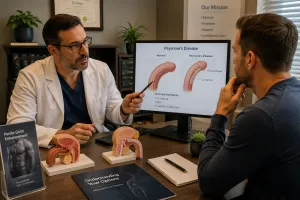
This is a genuinely important question that deserves a careful, honest answer rather than a simple yes or no. Peyronie’s disease is a real medical condition involving scar tissue formation, and understanding how it relates to candidacy for elective girth enhancement requires thinking through both the disease itself and how cosmetic filler procedures interact with altered penile tissue.
Peyronie’s disease involves the formation of fibrous scar tissue, called plaque, within the tunica albuginea — the fibrous sheath surrounding the erectile tissue of the penis. This scar tissue can cause curvature during erection, pain, indentation or narrowing, and in some cases a reduction in erect length. Understanding this underlying condition is essential context before considering how it relates to girth enhancement candidacy specifically.
Understanding Peyronie’s Disease: Acute vs. Chronic Phase
Peyronie’s disease typically progresses through two distinct phases, and which phase a patient is in matters significantly for any conversation about elective cosmetic procedures. The acute phase involves active inflammation, with symptoms including pain (particularly during erection), and curvature that is actively changing or worsening over time. This phase commonly lasts somewhere in the range of 12 to 18 months, though the exact duration varies by individual.
The chronic phase follows, once the condition has stabilized — pain has typically resolved, and the curvature and any plaque have stopped progressing and become relatively fixed. This distinction between active and stable disease is central to nearly every clinical decision involving Peyronie’s disease, including whether any additional procedure, cosmetic or otherwise, should be considered.
Why Active Peyronie’s Disease Is a Reason to Wait
During the acute, active phase of Peyronie’s disease, proceeding with an elective cosmetic procedure like girth enhancement is not appropriate. Active inflammation and ongoing scar tissue formation mean the underlying anatomy is still changing, which creates genuine uncertainty about how filler would settle, interact with the affected tissue, or be affected by any subsequent treatment the active disease requires. Layering an elective cosmetic procedure onto an unstable, actively progressing medical condition introduces risk without a clear benefit, and appropriately delays cosmetic consideration until the underlying condition has been properly evaluated and stabilized.
“If someone comes to us mentioning Peyronie’s and it sounds like it might still be in that active phase — pain, curvature that’s still changing — the answer is always the same: see a urologist first. That’s not us passing the buck, it’s genuinely the responsible order of operations. You don’t want to add a cosmetic procedure into the middle of an active disease process.”
Chronic, Stable Peyronie’s Disease: A More Individualized Conversation
Once Peyronie’s disease has reached its chronic, stable phase — typically confirmed through appropriate urological evaluation and follow-up — the conversation around girth enhancement candidacy becomes more individualized, though it still requires careful consideration rather than treating it as identical to a standard candidacy evaluation.
Why Scar Tissue Changes the Technical Picture
The presence of scar tissue and any associated changes to the tunica albuginea’s structure and elasticity in the affected area means the tissue a provider is working with and around is genuinely different from unaffected anatomy. This affects injection technique considerations, including how filler may distribute in tissue with altered architecture, and requires a provider to have a clear, complete understanding of the specific location and extent of any plaque before considering any filler placement near it.
Coordination With a Urologist
For patients with a history of Peyronie’s disease who are considering girth enhancement once their condition has stabilized, coordination between the cosmetic provider and the patient’s urologist is a genuinely important part of a responsible approach, rather than an optional extra step. Confirming the disease is truly in a stable, chronic phase, understanding the specific location and characteristics of any plaque, and discussing whether any prior or ongoing Peyronie’s-specific treatment affects timing or technique are all questions this kind of coordination helps answer accurately.
What Girth Enhancement Does and Doesn’t Address
It’s important to be direct about this: girth enhancement filler does not treat Peyronie’s disease, does not dissolve or reduce existing scar tissue plaque, and does not correct curvature. These are fundamentally different clinical problems requiring different treatments — Peyronie’s disease has its own dedicated treatment pathways, including options like collagenase injections, traction therapy, or surgical correction in appropriate cases, all of which fall under a urologist’s care rather than a cosmetic girth enhancement provider’s scope.
Girth enhancement is a cosmetic volume procedure with a specific, separate purpose, and patients should have a clear, accurate understanding that pursuing it doesn’t address any aspect of their Peyronie’s disease itself. Conflating the two, or hoping girth enhancement might incidentally improve curvature, is a misunderstanding worth correcting directly during any consultation.
Full Disclosure Is Essential
Any patient with a current or past history of Peyronie’s disease considering girth enhancement should disclose this fully and specifically during consultation, including the current phase of the condition, any treatments received, and the location and characteristics of any known plaque. This isn’t a detail that can be safely omitted or minimized — it directly shapes whether and how a provider can safely proceed, and a provider who doesn’t have this full picture cannot make an appropriately informed decision about candidacy or technique.
What Peyronie’s is: fibrous scar tissue (plaque) in the tunica albuginea causing curvature, sometimes pain, and possible shortening.
Two phases: acute (active inflammation, pain, changing curvature, ~12-18 months) vs. chronic (stable, pain resolved, curvature fixed).
Active phase: NOT an appropriate time for elective girth enhancement — see a urologist first, let the condition stabilize.
Chronic/stable phase: a more individualized conversation, requiring careful evaluation of scar tissue location and tissue characteristics.
Coordination matters: cosmetic provider and urologist coordination is important, not optional, for patients with a Peyronie’s history.
What filler does NOT do: does not treat Peyronie’s, does not dissolve plaque, does not correct curvature — separate condition, separate treatment pathway.
Disclosure: full, specific disclosure of Peyronie’s history (phase, treatments, plaque details) is essential for safe candidacy evaluation.
For patients in the Fort Worth area with a Peyronie’s disease history who want a thorough, honest consultation about candidacy, non-surgical penile enlargement services in Fort Worth gives access to providers who take this kind of medical history seriously as part of a genuine evaluation. For the clinic’s overall approach to patient safety and appropriate candidacy screening, the girth enlargement clinic is the right starting point.
Frequently Asked Questions
Can I get girth enhancement if I have Peyronie’s disease?
This depends significantly on the phase of your condition and requires an individualized medical evaluation. Active, acute-phase Peyronie’s disease, involving ongoing inflammation, pain, or changing curvature, is not an appropriate time to pursue elective girth enhancement — a urologist should evaluate and manage the condition first. Once Peyronie’s disease has reached a stable, chronic phase, candidacy becomes a more individualized conversation involving careful evaluation of scar tissue location and characteristics, ideally with coordination between a urologist and the cosmetic provider.
Does girth enhancement filler treat Peyronie’s disease or correct curvature?
No. Girth enhancement filler does not treat Peyronie’s disease, does not dissolve or reduce existing scar tissue plaque, and does not correct curvature. These are separate clinical problems requiring different, dedicated treatments under a urologist’s care, such as collagenase injections, traction therapy, or surgical correction in appropriate cases. Girth enhancement is a cosmetic volume procedure with a distinct purpose and should not be pursued with an expectation that it will address curvature or underlying scar tissue.
What is the difference between acute and chronic Peyronie’s disease?
The acute phase involves active inflammation, with symptoms including pain (particularly during erection) and curvature that is actively changing or worsening, typically lasting around 12 to 18 months. The chronic phase follows once the condition stabilizes, with pain generally resolved and the curvature and any scar tissue plaque no longer progressing. This distinction matters significantly for treatment decisions, including whether any elective cosmetic procedure should be considered.
Why does scar tissue from Peyronie’s disease matter for girth enhancement technique?
Scar tissue and any associated changes to the tunica albuginea’s structure and elasticity mean the affected tissue is genuinely different from unaffected anatomy, which can affect how filler distributes and settles in that area. A provider needs a clear, complete understanding of the specific location and extent of any plaque before considering filler placement near it, which is part of why full disclosure and, ideally, coordination with a urologist is an important part of safe candidacy evaluation for patients with a Peyronie’s history.
Should I tell my girth enhancement provider about a Peyronie’s disease history?
Yes, absolutely, and this disclosure should be complete and specific, including the current phase of the condition, any treatments received, and the location and characteristics of any known plaque. This information directly shapes whether and how a provider can safely proceed, and omitting or minimizing it prevents a provider from making an appropriately informed decision about your candidacy or technique.
Should I see a urologist before considering girth enhancement if I have Peyronie’s symptoms?
Yes. Peyronie’s disease is a medical condition that should be diagnosed and managed by a urologist before any conversation about elective cosmetic girth enhancement takes place. This is especially important if symptoms suggest the condition may still be in its active, acute phase, since proceeding with an elective cosmetic procedure during active disease progression is not appropriate and could complicate both the underlying condition and any cosmetic outcome.