
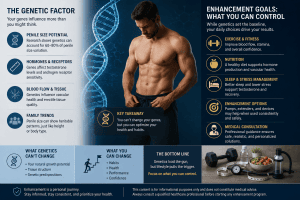
Genetics determine your baseline. Enhancement addresses what you want to change about that baseline. Understanding the relationship between the two is the foundation for realistic goal-setting and genuine satisfaction with the outcome.
The Genetics of Penile Anatomy: What Research Actually Shows
Penile dimensions are substantially heritable. Research on twins — the standard methodology for distinguishing genetic from environmental influences on physical traits — has consistently found that penile size has a significant genetic component, with heritability estimates in the range of 70-80% for length and somewhat lower but still substantial estimates for girth. This means that most of the variation in penile dimensions between men is attributable to genetic differences rather than to environmental factors like diet, exercise, or hormonal exposure (beyond the developmental hormonal environment in utero and during puberty).
The hereditary factors involved are polygenic — meaning many genes contribute small effects rather than a single gene determining the outcome. The gene variants involved include those regulating androgen receptor sensitivity (how strongly the developing tissue responds to testosterone during fetal and pubertal development), vascular development genes, and genes influencing connective tissue composition and growth.
Ethnic background has been documented to influence population-level averages for penile dimensions, though the variation within any ethnic group is substantially larger than the variation between group averages — which means ethnic background is a weak predictor for any specific individual and should not be used as a basis for expectation-setting in a clinical context.
“Understanding that most of what determines your baseline anatomy was settled long before you had any say in the matter is not a reason for resignation. It’s a starting point for an informed conversation about what you actually want to change.”
Puberty, Hormones, and Developmental Genetics
Penile development occurs in two primary windows: the early fetal period, when the initial differentiation and early growth occurs under the influence of androgens, and puberty, when the second major growth phase occurs under the influence of testosterone and related hormones. The genetic contribution to the final adult anatomy operates substantially through these hormonal environments.
The androgen receptor gene (AR), located on the X chromosome, encodes the protein through which testosterone exerts its effects on target tissues including penile tissue. Variants in the CAG repeat length within the AR gene affect receptor sensitivity — shorter repeat lengths are associated with higher androgen receptor activity. The relationship between AR gene variants and penile dimensions is real but modest in effect size; it’s one of many genetic contributors rather than a primary determinant.
The practical implication of this developmental biology for male anatomy and enhancement: adult penile anatomy is fixed in terms of underlying structure. The corpora cavernosa — the paired erectile chambers that determine the structural dimensions — are established by the end of puberty and don’t change meaningfully with hormonal changes in adulthood. This is why testosterone supplementation in adult men, even at supraphysiologic levels, does not produce meaningful changes in penile dimensions — the developmental window for hormonal influence on these structures has closed.
What Genetics Does and Doesn’t Determine
Being specific about what genetic inheritance actually does and doesn’t control is useful for enhancement planning conversations.
What Genetics Determines
The underlying structural dimensions of penile anatomy — the diameter of the corpora cavernosa, the elasticity and extensibility of the tunica albuginea (the fibrous sheath surrounding the erectile chambers), the baseline girth in both flaccid and erect states. These are set by developmental genetics and are not alterable through lifestyle, exercise, or hormonal manipulation in adulthood.
What Genetics Doesn’t Determine — Entirely
Body weight and its distribution affect the apparent dimensions of the anatomy. Significant excess weight in the suprapubic area (the fat pad above and around the base of the penis) obscures the base of the shaft, reducing apparent dimensions. Weight loss that reduces this fat pad can produce meaningful improvements in visible dimensions without any structural change to the anatomy itself. This is a legitimate and underrecognized factor in the enhancement conversation.
Vascular health affects erectile quality and consequently erect dimensions. Cardiovascular disease, diabetes, and other vascular conditions that impair blood flow can reduce the quality of erection and consequently the dimensions achieved during erection. Addressing these factors through health management can improve erect dimensions toward the genetic baseline even when the baseline itself hasn’t changed.
The Role of Genetics in Setting Enhancement Goals
Understanding the genetic baseline has practical implications for girth expectations and the enhancement planning process.
First, it reframes the starting point. A man who understands that his baseline anatomy is substantially genetically determined can approach the enhancement conversation from a place of neutral starting-point rather than from a narrative of inadequacy. The baseline is what it is — the question is what you want to achieve from it, not why the baseline is what it is.
Second, it clarifies what enhancement can and can’t do. Hyaluronic acid filler adds volume to the tissue above and surrounding the structural anatomy — it changes the external girth and the tactile and visual character of the anatomy without altering the underlying structural dimensions. This distinction matters for setting accurate expectations: enhancement produces real, meaningful results, but it does so by adding to the existing anatomy rather than changing the anatomy’s own structure.
Third, it informs what outcomes are realistic for a specific patient. Tissue characteristics that are themselves genetically influenced — skin elasticity, subcutaneous tissue density, tissue compliance — affect how filler distributes and integrates. A thorough tissue assessment by an experienced provider accounts for these characteristics in determining appropriate volume and technique.
Body Confidence and Genetics: The Psychological Dimension
The relationship between genetics and body confidence is worth addressing directly because it’s present in almost every consultation conversation, even when it’s not explicitly named.
Concerns about penile girth don’t arise in a vacuum — they develop in the context of comparison, exposure to idealized or unrealistic representations, social dynamics, and the particular vulnerability that sexual self-perception involves. The genetic reality that most of the variation between men is genetically determined — that the comparison itself is largely to genetically different baselines — doesn’t make the confidence concern less real, but it does change the framework for addressing it.
Enhancement addresses a specific, targeted aspect of physical self-perception. It works best when it’s approached as what it is — a tool for personal agency over a specific concern — rather than as a correction for a genetic failure or as a competition with a reference point that may itself be unrealistic. The men who report the highest satisfaction from enhancement tend to be those with specific, realistic goals and a clear understanding that they’re doing this for themselves.
Your baseline anatomy is substantially genetically determined — not a reflection of anything changeable you did or didn’t do. Enhancement adds volume to that baseline; it doesn’t correct a defect. The tissue characteristics that influence how enhancement results appear and how long they last are also partly genetic — skin elasticity, tissue compliance, metabolic rate all have heritable components. A thorough clinical assessment accounts for your individual characteristics, including these, in calibrating treatment. The goal of the consultation is to understand your specific situation and build a realistic, satisfying plan around it — not to fit you to an average.
For patients in the Argyle, Texas area exploring enhancement options, the penis enhancement and girth enlargement services in Argyle offer the individualized consultation that this kind of goal-setting discussion requires. And for the full overview of the clinic’s approach, process, and how enhancement planning works from initial consultation through treatment, the girth enlargement clinic is the starting point.
Frequently Asked Questions
Is penile girth primarily determined by genetics?
Yes. Research using twin study methodology — the standard approach for distinguishing genetic from environmental influences — has found that penile dimensions are substantially heritable, with estimates in the 70-80% range for length and somewhat lower but still substantial heritability for girth. This means most variation between men in penile dimensions is attributable to genetic differences rather than to environmental factors. The genetic contribution operates through multiple genes affecting androgen receptor sensitivity, vascular development, and connective tissue composition — it’s a polygenic trait rather than one determined by a single gene.
Can testosterone supplementation increase penile girth in adults?
No, not meaningfully. The developmental windows during which testosterone drives penile growth — the early fetal period and puberty — close by the end of adolescence. After this, adult testosterone levels do not produce further structural growth of the penile anatomy. The corpora cavernosa (the erectile chambers that determine the structural dimensions) are established by the end of puberty. Testosterone supplementation in adult men, even at supraphysiologic levels, does not produce meaningful increases in penile dimensions. It may improve erectile quality in men with hypogonadism (low testosterone), which can improve erect dimensions toward the patient’s genetic baseline — but this is restoring function rather than enlarging anatomy.
Does body weight affect penile girth or apparent dimensions?
Yes, through the suprapubic fat pad. The fatty tissue above and around the base of the penis partially obscures the shaft in men with excess weight in this area, reducing apparent dimensions without any structural change to the anatomy itself. Significant weight loss that reduces the suprapubic fat pad can produce meaningful improvements in visible and functional dimensions. This is a legitimate and often underemphasized factor in the enhancement discussion — for overweight men considering enhancement, weight management that addresses the suprapubic fat pad can improve apparent dimensions complementarily to or independently from filler-based enhancement.
How does understanding genetics help with enhancement goal-setting?
Understanding that baseline anatomy is substantially genetically determined reframes the starting point of the enhancement conversation — it’s a neutral biological fact rather than a reflection of failure or inadequacy. This framing supports clearer, more realistic goal-setting: the question becomes what you want to achieve from your actual baseline rather than how to correct a deficiency. It also clarifies what enhancement can and can’t do — filler-based enhancement adds volume to the existing anatomy rather than altering its structure, which is a real and meaningful change but a specific and bounded one. Accurate expectations are the foundation of satisfaction with outcomes.
Are tissue characteristics relevant to enhancement also genetically influenced?
Yes. Several tissue characteristics that affect how girth enhancement results appear and how long they last have genetic components. Skin elasticity and tissue compliance — which affect how filler distributes and integrates — are partly determined by genetics through collagen and elastin gene variants. Resting metabolic rate, which influences how quickly hyaluronic acid filler is metabolized, has substantial genetic heritability. These characteristics mean that two patients with the same treatment volume can see different results and different longevity, which is why individual tissue assessment and personalized treatment calibration produce better outcomes than a one-size approach.
Does ethnic background predict penile girth?
Population-level research has documented differences in average penile dimensions across ethnic groups, but the practical clinical relevance of these averages for any specific individual is limited. The variation in penile dimensions within any ethnic population is substantially larger than the average difference between ethnic populations — meaning ethnic background is a very weak predictor for an individual patient. A clinical assessment based on the individual’s actual tissue characteristics and personal goals is meaningfully more informative than any population-level average. Ethnic background should not be used as a basis for individual expectation-setting in an enhancement consultation.