
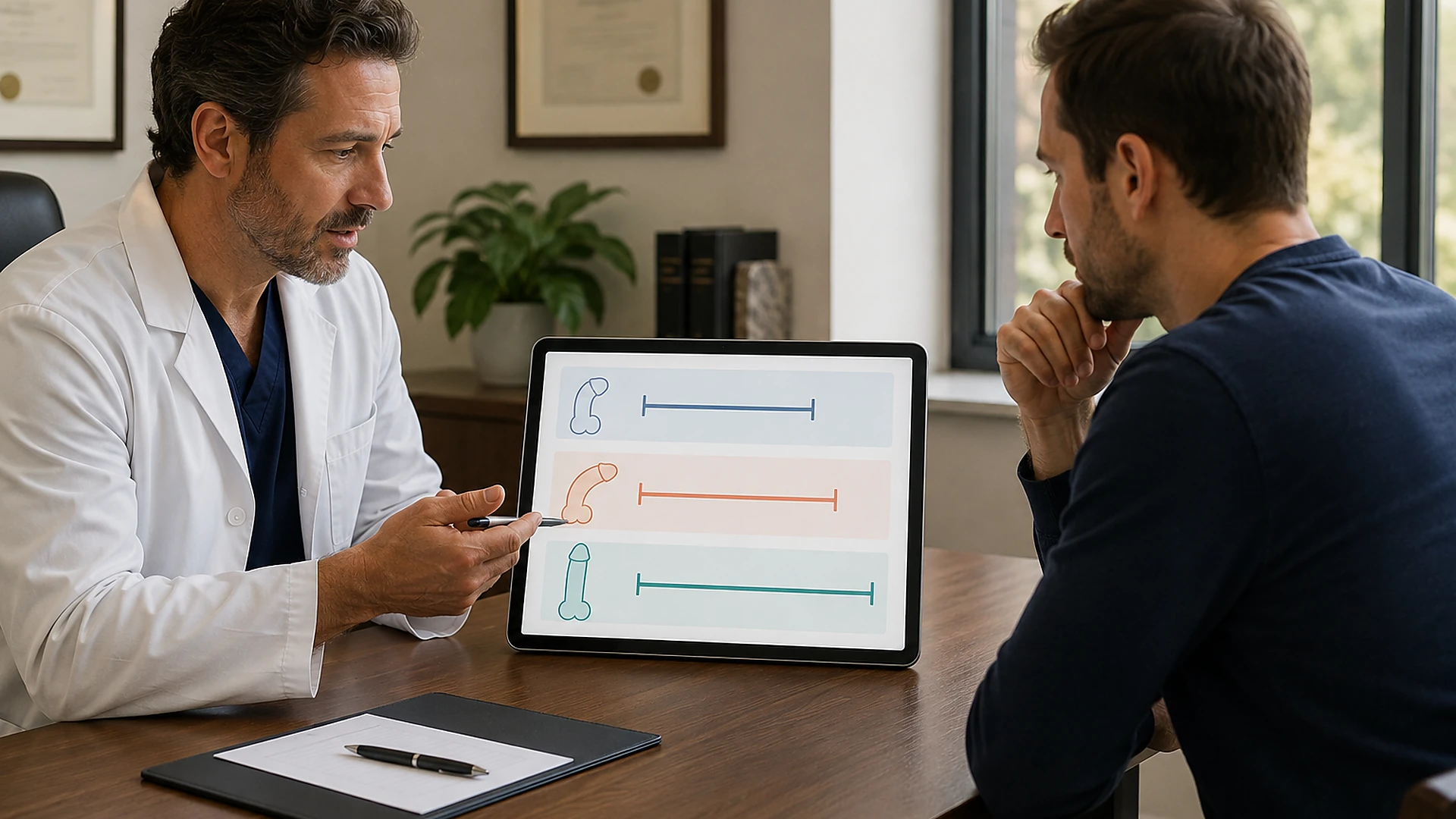
The latest clinician-measured evidence places the average erect length at 13.84 cm, or 5.45 inches. That figure only answers one part of the question because flaccid, stretched, and erect measurements describe different states. This guide compares all three, explains why credible sources report slightly different results, and shows when a measurement deserves professional assessment.
This article focuses on length. If you also want to understand width, see our comparison of penis girth versus length.
Quick Answer: What Is the Average Penis Length When Erect?
A 2025 systematic review and meta-analysis found a mean erect length of 13.84 cm, or 5.45 inches. Researchers calculated that figure from clinician-measured data involving 5,669 men.
Treat 5.45 inches as a population average, not a cutoff that separates “normal” from “abnormal.” A personal measurement above or below the mean does not diagnose a condition or show whether someone needs treatment.
Average Penis Length by Measurement State
The most useful answer depends on the state being measured. The 2025 systematic review included 33 studies and 36,883 participants overall. Each pooled estimate used a different subset because not every study measured every state.
| Measurement state | Mean length | Sample used for the estimate | What the figure describes |
| Flaccid | 9.22 cm / 3.63 in | 28,201 | Resting, unstretched length |
| Stretched | 12.84 cm / 5.06 in | 20,814 | Flaccid length under standardized extension |
| Erect | 13.84 cm / 5.45 in | 5,669 | Length during erection |
These figures offer reference points, but they do not create one universal standard for every person. Study populations, anatomical reference points, examiner technique, and conditions can all shift the result.
The values in the table are means, not the upper and lower limits of a healthy range. A mean adds the measured values and divides the total by the number of participants. Individual measurements naturally fall on both sides of it.
The sample size also changes by state. The review had far more flaccid and stretched measurements than erect measurements. That difference matters when interpreting how precise each estimate is, even though all three figures come from the same review.
The difference between states also explains why one number cannot answer every search. Someone asking about flaccid average length needs the flaccid estimate. Someone comparing an erect measurement should use clinician-measured erect data.
What Flaccid, Stretched, and Erect Length Actually Mean
The three measurement states describe different physical conditions. They should appear together in an evidence summary, but they should not be treated as interchangeable.
Flaccid length
Flaccid length refers to the penis at rest without stretching. Temperature, stress, recent physical activity, and other temporary factors can change its appearance. A single flaccid measurement may therefore differ from another measurement taken under different conditions.
The average flaccid length in the 2025 review was 9.22 cm, or 3.63 inches. That result describes the pooled mean across the included studies. It does not predict one person’s erect length with enough accuracy to replace an erect measurement.
Stretched length
Stretched penile length measures the flaccid penis while gently extending it. Clinicians commonly use this state because it allows a more standardized assessment than an ordinary resting measurement.
The European Association of Urology describes stretched length as the distance from the pubic symphysis to the tip of the glans. The 2025 review reported an average stretched length of 12.84 cm, or 5.06 inches.
Stretched length can approximate erect length in some settings, but it is not identical to an erection. Technique, pressure at the pubic area, and the amount of extension can affect the result.
Erect length
Erect length measures the penis during an erection. This is the most relevant state for anyone asking how long the average penile length is when erect.
The 2025 pooled mean was 13.84 cm, or 5.45 inches. Erect measurements can still vary with erection quality, anatomical reference points, and study protocol, so always consider the number alongside its source and method.
Why Average Penis-Length Results Differ Between Studies
Credible articles sometimes give averages closer to 5.1 inches, while others report about 5.5 inches. That difference does not automatically make either source wrong.
An often-cited 2015 systematic review reported mean lengths of 9.16 cm flaccid, 13.24 cm stretched, and 13.12 cm erect. The newer review reported 9.22 cm flaccid, 12.84 cm stretched, and 13.84 cm erect. The reviews included different studies, samples, and measurement conditions.
A separate systematic review of penile measurement methods examined 70 studies and found substantial variation in how researchers collected measurements. Important differences included:
- Whether a clinician or participant took the measurement
- Whether the study measured from the skin or pubic bone
- How the examiner handled the pubic fat pad
- Whether the penis was flaccid, stretched, or erect
- The participant’s position and examination conditions
- The ruler or measuring instrument used
Self-reported measurements create another problem. People may use inconsistent reference points, measure along a different surface, or volunteer because they feel more comfortable with their size. Clinician-measured studies reduce some of those problems, but they do not remove every source of variation.
The starting point can make a visible difference. A skin-to-tip measurement begins where the skin meets the shaft. A bone-to-tip measurement presses through the pubic fat pad to reach the pubic bone. Articles that quote a number without naming the method leave out information needed for a fair comparison.
What the evidence supports
Large clinician-measured reviews place mean erect length within the low-to-mid 5-inch range. They also show that flaccid, stretched, and erect length need separate labels.
What remains uncertain
Researchers have not adopted one measurement protocol across every study. No pooled average can determine how one person should feel about his body, whether sex will be satisfying, or whether cosmetic treatment makes sense.
Why Flaccid Length Does Not Reliably Predict Erect Length
Resting size and erect size do not have a fixed one-to-one relationship. Two men can have similar flaccid measurements but different erect measurements. The reverse can also occur.
This matters because a flaccid comparison can create unnecessary concern. Comparing a resting measurement with a 5.45-inch erect average combines two different states and produces no useful conclusion.
Use a flaccid reference for a flaccid measurement and an erect reference for an erect measurement. If you want to compare length with girth, review how girth and length answer different questions before drawing conclusions.
What Average Penis Length Can and Cannot Tell You
An average tells you where the arithmetic mean fell in a particular set of studies. It can correct inflated expectations and give a broad comparison point.
It cannot tell you whether your penis is healthy, whether you have erectile dysfunction, whether a partner will feel satisfied, or whether you need enhancement. It also cannot measure confidence, intimacy, fertility, or sexual skill.
Online comparison often distorts the question. Adult content features selected performers rather than a representative sample. Anonymous surveys may rely on self-measurement. Country rankings may combine data from studies that used different methods and samples.
The better question is not simply, “Am I above or below average?” Ask whether you measured the same state using comparable reference points and whether you have any physical or emotional concern that affects daily life.
Repeated checking rarely resolves uncertainty when the comparison method keeps changing. Before measuring again, decide which state you want to compare, use the same anatomical starting point, and record the conditions. If the concern remains despite a stable result, the issue may require more than another number.
If comparison has started to affect confidence or intimacy, our article on male confidence and genital self-image addresses that part of the decision. Measurement can provide context, but it cannot settle a body-image concern on its own.
When Does Penis Size Merit a Clinical Assessment?
A measurement deserves medical attention when it comes with a developmental concern, a noticeable change, pain, curvature, erectile difficulty, urinary problems, or significant distress. A urologist or sexual-medicine clinician can assess the concern in context.
Professional assessment also matters before any cosmetic procedure. A clinician can confirm what the measurement represents, identify conditions that may change apparent length, and discuss whether the requested outcome matches what a treatment can reasonably address.
The European Association of Urology guideline separates several conditions that people often group together:
- True micropenis: A congenital condition in which stretched length falls more than 2.5 standard deviations below the appropriate population mean
- Buried penis: A normally developed penis that surrounding tissue or skin partly conceals
- Acquired shortening: A change associated with another condition, injury, or treatment
- Small penis anxiety: Persistent concern about a penis that falls within the expected range
- Penile dysmorphic disorder: A preoccupation with a perceived flaw that causes substantial distress or interferes with daily life
Do not use a web article to diagnose any of these conditions. A clinician may review medical and sexual history, perform an examination, measure stretched length, assess girth and shape, and screen for body-image distress when appropriate.
Girth Penis Enlargement describes its care team and approach to privacy for readers considering a professional discussion. A consultation should clarify anatomy, goals, evidence, limitations, and risk before any treatment decision.
Common Myths About Average Penis Length
Myth: One average tells me whether I am medically normal
A mean describes the center of a dataset. It does not create a diagnosis. Clinical assessment considers measurement method, age and developmental history, anatomy, symptoms, function, and distress.
Myth: Flaccid size tells me exactly how long I will be when erect
Flaccid length does not convert to erect length through a fixed formula. Compare each measurement with data from the same state.
Myth: A country ranking predicts an individual person’s size
Regional studies can show pooled differences, but they cannot predict one individual. Sampling, measurement technique, and variation within each population limit personal conclusions.
Myth: Being below average means treatment is necessary
Below average is a statistical description, not a treatment indication. Symptoms, function, personal goals, expectations, and medical assessment matter more than rank within a dataset.
A More Useful Next Step Than Chasing One Number
Start by identifying the question you actually need answered. If you only want a credible benchmark, the three-state comparison above may be enough. If you have pain, functional changes, or persistent distress, speak with an appropriate clinician.
If you are considering cosmetic enhancement, separate length from girth. The clinic’s non-surgical penis enlargement overview explains its girth-focused service, while the penis girth enhancement page describes the treatment category in more detail. These services address girth rather than anatomical length.
Review the clinic’s treatment process before deciding whether a private consultation fits your goals. A responsible decision should account for your starting anatomy, expectations, possible risks, alternatives, and the option to do nothing.
Final Thoughts on Average Penis Length
The clearest evidence-based answer uses three figures, not one. The 2025 pooled means were 3.63 inches flaccid, 5.06 inches stretched, and 5.45 inches erect.
Compare the same measurement state, keep the study method in view, and do not treat an average as a diagnosis. If your concern involves symptoms, a physical change, or persistent distress, a professional assessment will provide more useful information than another online comparison.
Frequently Asked Questions
What’s the average penile length?
The 2025 clinician-measured meta-analysis found mean lengths of 3.63 inches flaccid, 5.06 inches stretched, and 5.45 inches erect. The correct comparison depends on which state you measured.
What is the average penis length when erect?
The latest pooled clinician-measured estimate is 13.84 cm, or 5.45 inches. Researchers calculated that mean from erect measurements involving 5,669 men.
What is the average flaccid penis length?
The 2025 review reported an average flaccid length of 9.22 cm, or 3.63 inches. Temperature, stress, and examination conditions can change resting appearance.
What is the average stretched penis length?
The same review found an average stretched length of 12.84 cm, or 5.06 inches. Clinicians often use stretched length during assessment, but it is not identical to erect length.
How long is the average penile length?
The average is about 5.45 inches when erect, 5.06 inches when stretched, and 3.63 inches when flaccid, based on the 2025 review. State the measurement condition whenever you quote or compare a number.
Why do average penis-length figures differ between sources?
Sources may use different samples, anatomical reference points, measurement tools, and erection states. Self-reported results may also differ from measurements collected by healthcare professionals.
Does flaccid length predict erect length?
Flaccid length does not reliably predict one person’s erect length. Use a flaccid reference for a flaccid measurement and an erect reference for an erect measurement.
How do clinicians measure penis length?
Clinicians may measure stretched length from the pubic bone or penopubic skin junction to the tip of the glans. The exact method should appear beside any result because the reference point and technique can change the measurement.
When should I speak with a urologist about penis size?
Seek an assessment if you notice pain, curvature, erectile difficulty, urinary problems, developmental concerns, acquired shortening, or distress that interferes with daily life. A clinician can distinguish normal variation from a medical or psychological concern.
Request a private consultation if you want to discuss your goals with the clinic before considering a girth-focused treatment.