
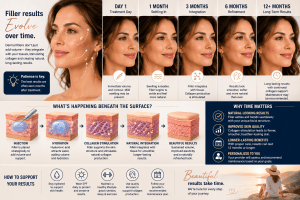
The procedure day is the beginning of the result, not the end of it. What happens to hyaluronic acid filler in the weeks and months after girth enhancement is a process — and understanding that process helps patients interpret their results accurately rather than comparing day-30 to day-1 and reaching the wrong conclusions.
The honest answer to most of these questions is: yes, this is normal. And the reason it’s normal is that filler integration after girth enhancement is a dynamic biological process that continues for weeks to months after treatment — not a static result that’s frozen in place from day one. Understanding the timeline of what happens helps patients recognize expected changes and distinguish them from the unexpected ones that warrant a call to the provider.
The First Two Weeks: Settling and Initial Swelling Resolution
The immediate post-procedure period involves swelling that can make the result look more dramatic than the final outcome, and in some patients, bruising that temporarily affects the appearance of the treated area. Both of these are expected and resolve as the tissue recovers from the procedure itself.
Swelling in the first 48 to 72 hours is typically at its maximum and then progressively resolves over the following 7 to 14 days. The rate of resolution varies between patients based on individual inflammatory response, whether the patient followed post-procedure instructions (particularly around avoiding physical activity that increases blood flow to the area), and individual healing characteristics. Some patients see most of the swelling resolve in 5 to 7 days; others take the full two weeks.
What the result looks like during the first two weeks is not what it will look like at 6 weeks. This is an important expectation-setting point that some patients don’t fully internalize — the dramatic-looking immediate result gives way to a more settled appearance as swelling resolves, and patients sometimes interpret this as “the result shrinking” when it’s actually the result revealing itself from behind post-procedure swelling.
Weeks Two Through Six: Tissue Adaptation and Filler Integration
After the initial swelling resolves, the tissue begins the process of adapting to the presence of the filler material. Hyaluronic acid is hydrophilic — it attracts and binds water molecules — and this property causes it to continue to expand slightly as it equilibrates with the tissue’s water content over the weeks after placement. This mild hydration expansion is part of why the final result at 6 weeks looks somewhat different from the result at 2 weeks: the filler has had time to reach its full hydrated state.
During this period, patients often notice that the filler feels different to the touch — softer, less distinct, more integrated with the surrounding tissue. This is the expected trajectory of tissue adaptation as the filler settles into the tissue planes where it was placed. The immediate post-procedure result often has some firmness as the tissue adjusts; the result 4 to 6 weeks out is typically softer and more natural in texture.
“The result at 6 weeks is the baseline result. Everything before that is the process of getting there. Patients who evaluate their outcome at 2 weeks are measuring during the journey rather than at the destination.”
The Collagen Response: How the Tissue Responds to HA Filler
One of the less commonly discussed aspects of HA filler outcomes is the collagen response that the filler stimulates in the surrounding tissue. Hyaluronic acid in the tissue activates fibroblast activity — the cells responsible for collagen production — through mechanical pressure on the extracellular matrix and through specific biochemical signaling pathways. The result is a modest neocollagenesis (new collagen formation) in the tissue surrounding the filler.
This collagen response has two practical effects on the patient’s experience. First, it can contribute to a longer-lasting result than the HA filler volume alone would suggest — as the filler gradually degrades, the new collagen that has formed provides some ongoing tissue support. Second, it means that patients who have had multiple treatments over time sometimes notice that their results from each treatment are somewhat longer-lasting than the previous one, as the cumulative collagen response builds a more supportive tissue environment around each subsequent treatment.
The collagen response doesn’t substitute for the filler — when the HA fully degrades, the collagen response it stimulated doesn’t maintain the full volume of the original result. But it does partially explain why repeat treatment patients often report that their results feel particularly natural over time, as the filler volume and the collagen response together produce a more integrated tissue environment than either would alone.
Months Three Through Twelve: Result Stability and the Onset of Degradation
Most patients experience the most stable and satisfying version of their result between approximately 6 weeks and 6 months post-treatment. The filler is fully integrated, the tissue has adapted, the collagen response has developed, and the HA degradation has not yet progressed far enough to produce noticeable volume reduction. This is the period that most closely matches the target outcome of the treatment.
HA filler degradation is a gradual process managed by the enzyme hyaluronidase, which is naturally present in the body’s tissues. The degradation rate depends on the specific HA product used (higher cross-linked products degrade more slowly), the volume placed, the individual patient’s metabolic rate, and the tissue environment. Most patients begin to notice some reduction in fullness sometime between 9 and 18 months after treatment, though the range extends meaningfully in both directions.
How Results Change During Degradation
The degradation of HA filler is typically even and gradual rather than sudden or asymmetric. Patients usually notice that the results feel slightly less full or that the visual change they valued is slightly less prominent — a progressive reduction in the volume effect rather than a sudden change. This gradual progression gives patients time to schedule a touch-up treatment at the point where the result no longer meets their goal, rather than reaching a sudden loss of result.
Asymmetric or irregular changes — one area reducing faster than another, a specific lump or texture change that wasn’t there before — are different from expected gradual degradation and warrant a consultation with the provider. These can represent focal hyaluronidase accumulation in a specific area, migration of a small amount of filler (unusual but possible), or the development of a small inflammatory granuloma. Each of these has a management approach; the key is not ignoring them in favor of assuming they’re part of expected degradation.
The Maintenance Question: When to Retreat
The timing of enhancement maintenance treatment is a personal decision that depends on the individual patient’s result, their goal, and their subjective sense of when the result no longer meets their expectation. There is no universal schedule — some patients retreat at 12 months as a matter of routine maintenance; others wait until they notice the result has degraded below their satisfaction threshold.
The general guidance from experienced providers is to schedule a follow-up consultation when you first notice the result beginning to reduce rather than waiting until it has significantly diminished. Touch-up treatment at an early point of degradation requires less volume than treatment after significant loss has occurred, and the result of treating into partially degraded filler is often more natural than fully retreating from baseline. This is the maintenance approach that produces the best long-term outcome trajectory for repeat patients.
Days 1–14: Swelling resolution. Result is over-expressed due to post-procedure swelling.
Weeks 2–6: Tissue adaptation. Filler softens and integrates with surrounding tissue. Hydration expansion completes.
Weeks 6–24: Result stability. Filler fully integrated, collagen response developed, optimal result period for most patients.
Months 9–18 (variable): Gradual degradation onset. Progressive volume reduction; individual timing varies significantly.
Retreatment indicator: When the result no longer meets the patient’s goal — ideally at early degradation rather than significant loss.
For patients in the Fort Worth, Texas area who have questions about their post-treatment results or who are considering maintenance treatment, male enhancement services in Fort Worth, Texas provide the clinical follow-up expertise that post-treatment evaluation requires. For the full picture of the clinic’s approach to treatment outcomes and ongoing patient care, the girth enlargement clinic is the right starting point.
Frequently Asked Questions
Why does the result look different at 6 weeks than at 2 weeks?
The change between 2 weeks and 6 weeks reflects two processes: the resolution of residual post-procedure swelling, which can make the immediate result look more dramatic than the final outcome, and the hydration equilibration of the HA filler, which causes modest expansion as the material absorbs water from the surrounding tissue over the first several weeks. The result at 6 weeks is typically softer, more naturally integrated with the surrounding tissue, and more representative of the stable final outcome than the result at 2 weeks. Evaluating the result before 6 weeks — particularly before 4 weeks — is evaluating the outcome before it has stabilized.
Is it normal for filler to feel firm after girth enhancement?
Some firmness in the first 2 to 4 weeks after treatment is expected and normal — the tissue is adapting to the presence of the filler, and this adaptation period often involves slightly more firmness than the final result will have. As the tissue adapts and the filler integrates over 4 to 6 weeks, the texture typically softens to a more natural consistency. Firmness that persists beyond 6 weeks, is asymmetric (one area significantly firmer than another), or is accompanied by tenderness, redness, or visible surface irregularity warrants a consultation with the treating provider — these can indicate a localized inflammatory response or small granuloma that needs clinical evaluation.
What is the collagen response to HA filler and why does it matter?
Hyaluronic acid filler in the tissue activates fibroblasts — the cells responsible for collagen production — through mechanical pressure on the extracellular matrix and biochemical signaling. This produces a modest neocollagenesis (new collagen formation) around the filler material that contributes to tissue support and can slightly extend the effective duration of results beyond what the HA volume alone would provide. Patients who have had multiple treatments sometimes report that results feel increasingly natural over time, which is partly attributable to this cumulative collagen response building a more supportive tissue environment. The collagen response doesn’t replace the filler volume — when HA degrades, it doesn’t maintain full volume — but it contributes to a more integrated, natural-feeling result.
How long do girth enhancement filler results typically last?
Most patients experience results for 12 to 24 months, with significant individual variation. The specific HA product used, the volume placed, the patient’s metabolic rate, and the tissue environment all affect degradation timing. Highly cross-linked HA products designed for structural support degrade more slowly than lighter formulations. Patients with higher metabolic rates — younger patients and those with more physically active lifestyles — sometimes see faster degradation than the average range. Most patients begin noticing gradual volume reduction at some point between 9 and 18 months. Following up with the provider when the result first begins to decline rather than waiting for significant loss produces better maintenance outcomes and typically requires less retreatment volume.
What should I watch for that indicates something has gone wrong rather than expected degradation?
Expected degradation is gradual, even, and symmetric — a progressive and uniform reduction in the volume effect over months. Signs that warrant a provider consultation rather than watching and waiting include: asymmetric reduction where one area is degrading significantly faster than another, development of new firmness, lumpiness, or surface irregularity that wasn’t present at the stable result stage, any redness, warmth, or tenderness in the treated area developing after the initial recovery period has passed, or sudden rather than gradual change in the result. These can indicate focal hyaluronidase accumulation, migration of a small filler portion, or development of an inflammatory granuloma — all of which have clinical management approaches but need to be evaluated by the provider rather than assumed to be normal degradation.
When is the best time to schedule a touch-up treatment?
The optimal timing for touch-up treatment is when you first notice the result beginning to decline below your satisfaction threshold — not when significant volume has been lost. Retreating into partially degraded filler requires less volume than retreating from a fully degraded baseline, and the result of building on residual filler is typically more natural-looking than the result of starting over. Most providers recommend scheduling a follow-up consultation when the result first begins to feel diminished rather than waiting until it is substantially gone. The specific timing varies by patient — some schedule maintenance annually as a routine, others wait for the subjective signal that the result no longer meets their goal. Either approach works; the early-signal approach generally requires less total treatment volume over time.