
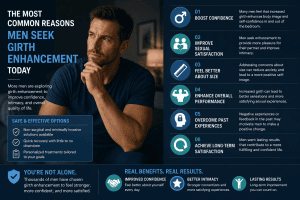
The conversation in the consultation room is usually more nuanced than people outside of it assume. Men who seek girth enhancement aren’t a monolith. Their reasons are varied, personal, and in most cases, entirely reasonable.
Reason One: A Long-Standing Concern Finally Being Addressed
For a significant number of men, the decision to pursue girth enhancement isn’t a new idea. It’s a concern they’ve carried for years — sometimes decades — that they’re finally in a position to do something about. The combination of greater awareness of what’s available, increased financial capacity in midlife, and the maturity to act on a long-standing personal concern rather than dismiss it as not worth addressing is the context for many consultations.
These patients typically have clear, specific motivations. They’ve thought about this carefully. They’re not making an impulsive decision. And the relief they describe after a successful procedure is often disproportionate to the scale of the change — because what’s being resolved isn’t just an aesthetic concern but a burden they’ve been carrying silently for a long time.
The clinical literature on elective aesthetic procedures consistently finds that patients with specific, long-standing concerns and realistic expectations report higher satisfaction than those with more recent, reactive motivations. Men in this category are typically good candidates for the consultation conversation specifically because their goals are clear and grounded.
“The men who’ve been thinking about this for fifteen years and finally made the appointment tend to know exactly what they want. The clarity is part of the history.”
Reason Two: Confidence in Intimate Situations
The most common explicit motivation cited in consultations is some form of this: a desire to feel more confident in intimate situations, to not be distracted by self-consciousness about girth when that attention belongs somewhere else entirely. This is the reason that connects most directly to male confidence and to the broader question of sexual self-perception.
It’s worth taking this seriously rather than dismissing it. The relationship between physical self-confidence and the quality of intimate experience is well-documented in psychological literature — anxiety about one’s own body in an intimate context is a genuine inhibitor of presence, connection, and satisfaction. A man who is self-conscious about his girth is not fully present in an intimate moment; part of his attention is elsewhere. Enhancement that addresses the underlying concern can produce a meaningful change in this experience, and the change isn’t purely physical.
The patients who describe this motivation most clearly are not necessarily those whose anatomy falls outside any objective standard. They’re men for whom a specific aspect of self-perception has become an active distraction — one that a realistic, achievable change can resolve. The resolution tends to be durable because it addresses something real rather than imagined.
Reason Three: Aesthetic Goals and Body Image
Not all enhancement motivation comes from a place of anxiety or long-standing concern. For some men, the aesthetic goals are more straightforward — they have a specific idea of how they’d like their anatomy to look, and enhancement is the tool for achieving it. This is the same framing that drives countless other aesthetic procedures, from rhinoplasty to body contouring, and it deserves the same neutral, patient-centered consideration.
Men in this category often approach the consultation with a more practical orientation — they want to understand what’s achievable, how the procedure works, and how the outcome compares to their goal. They’re less likely to have years of emotional weight attached to the decision and more likely to be evaluating it the way they’d evaluate any other personal improvement investment.
The clinical approach for these patients is the same as for anyone else: honest expectation-setting, thorough tissue assessment, and treatment calibrated to what’s actually achievable for this specific person’s anatomy. The aesthetics goal is valid; the role of the consultation is to translate that goal into a realistic and satisfying outcome.
Reason Four: Relationship Context and Partner Considerations
A meaningful subset of men who seek girth enhancement do so in the context of a relationship — motivated by a desire to improve the intimate dimension of a relationship they care about, or following explicit or implicit feedback that this aspect of their anatomy is a factor in their partner’s experience. This is a more complex and sensitive motivation that deserves honest acknowledgment.
When the motivation comes from a place of genuine desire to improve a relationship dimension that both partners care about, enhancement can play a positive role. The man who pursues this thoughtfully, with realistic expectations, tends to report positive outcomes in both the physical and relational dimensions.
When the motivation comes primarily from anxiety about a partner’s stated or perceived dissatisfaction, the relationship between the procedure and the underlying concern is more complicated. Enhancement addresses one specific dimension — it doesn’t resolve relationship dynamics that are about something broader. The consultation is an appropriate place to explore whether the stated motivation accurately represents what the patient is hoping to resolve.
Reason Five: Post-Aging Body Changes and Men’s Wellness
For older men, particularly those in their 50s and 60s, the motivation is sometimes specific to age-related changes. Body weight redistribution with age can affect the apparent dimensions of penile anatomy (the suprapubic fat pad increasing with weight gain), and changes in erectile quality related to vascular health can affect erect dimensions. For some men, enhancement addresses a specific change — the desire to restore a dimension of self-perception that has shifted with the natural changes of aging.
This motivation connects to a broader conversation about men’s wellness across the lifespan — the recognition that men’s physical self-perception and the confidence it supports are legitimate wellness concerns that deserve the same clinical attention as other aspects of aging-related health. The stigma around men’s aesthetic concerns often delays action on things that could meaningfully improve quality of life; in the wellness context, that delay isn’t serving anyone.
For men whose concerns about girth are connected to broader questions about sexual performance and vitality — including erectile function, stamina, and overall sexual health — procedures like the P-Shot address a related but different dimension. P-Shot treatment in Dallas is one of the complementary options worth understanding if girth is only part of the broader performance and wellness picture. And for everything about the clinic’s full range of services, the girth enlargement clinic is the right starting point.
The Common Thread: Personal Agency
What unites the most common reasons men seek girth enhancement is personal agency — the decision to address something that matters to them personally, rather than accepting a concern as permanent because of cultural messaging that male aesthetic concerns don’t deserve attention or because of a lack of awareness that accessible, realistic options exist.
The framing matters. Men who approach this as a deliberate, informed exercise of personal agency over something specific and meaningful in their lives tend to approach the consultation with clarity, engage with realistic expectations honestly, and report satisfaction with well-executed outcomes. Men who approach it from anxiety, comparison, or the hope that a physical change will resolve something deeper tend to have a more complicated relationship with the outcome regardless of its quality.
The goal is not to validate every motivation uncritically or to screen out men whose reasons aren’t sufficiently clinical. It’s to understand what the patient is actually hoping to achieve, assess whether enhancement can realistically address it, and be honest about what the procedure can and can’t deliver for this specific person. The consultation is where motivation becomes plan — and where the difference between a realistic, satisfying outcome and an unsatisfying one is usually established.
Frequently Asked Questions
Are the motivations for girth enhancement primarily psychological or physical?
Both, and the distinction isn’t as clean as it might seem. The concern that motivates enhancement is real and has genuine physical dimensions — the anatomy is what it is, and the desire to change it is a response to a physical reality. But the impact of that change is experienced primarily as a shift in self-perception, confidence, and the quality of intimate experience — which are psychological outcomes. The most accurate framing is that girth enhancement is a physical intervention whose most meaningful effects are often experienced at the level of confidence and self-perception. Both dimensions are legitimate and worth taking seriously.
Is seeking girth enhancement a sign of body dysmorphia?
Not typically. Body dysmorphic disorder (BDD) is a psychological condition characterized by obsessive preoccupation with a perceived flaw that others don’t observe, significant functional impairment, and a distorted perception of the body’s actual appearance. The vast majority of men who seek girth enhancement do not meet these criteria — they have a specific, realistic concern about an aspect of their anatomy and are pursuing a specific, realistic change. A clinical consultation that screens for BDD-related thinking patterns is part of responsible patient selection. Men whose concerns are disproportionate to any objective assessment, who are seeking repeated procedures without satisfaction, or who show other signs of body image distortion are not good candidates for enhancement and should be referred for appropriate psychological support.
Is it legitimate to want girth enhancement for primarily aesthetic reasons?
Yes. Aesthetic motivation — the desire for a specific appearance outcome — is a legitimate basis for any elective procedure. The same motivation that drives rhinoplasty, body contouring, or any other aesthetic procedure is legitimate when it drives girth enhancement. The clinical standard for assessment is the same: Is the goal specific and realistic? Does the patient have appropriate expectations for the outcome? Is the motivation personal and stable rather than reactive or externally pressured? Aesthetic goals that meet these criteria are entirely appropriate motivations for pursuing a consultation.
Should I tell my partner I’m considering girth enhancement?
This is a personal decision that depends on the relationship and the specific motivation. For men whose motivation is at least partly connected to the intimate relationship, transparency tends to support better outcomes — both partners understanding what’s being pursued and why reduces the potential for mismatched expectations about what the procedure will change. For men whose motivation is primarily personal and not directly tied to a partner’s stated concerns, the decision is as personal as any other aspect of medical care. The consultation itself is confidential, and the decision to disclose is entirely the patient’s.
How do I know if my reasons for seeking enhancement are appropriate?
The consultation is where this is properly evaluated. The general markers of appropriate motivation for elective aesthetic procedures include: a specific, stable concern that has been present for a meaningful period; realistic expectations for what the procedure can and can’t achieve; motivation that is personal and internal rather than primarily driven by external pressure or reactive circumstances; and the ability to accept and articulate the goal clearly. If your motivation meets these criteria, a consultation is the appropriate next step. If you’re uncertain whether your motivation is in the appropriate range, naming that uncertainty in the consultation is exactly the right approach — a good provider will help you evaluate it.
Does seeking girth enhancement mean there’s something wrong with me?
No. Seeking an elective procedure to address a specific concern about your body is a normal exercise of personal agency. Millions of people of all genders pursue aesthetic procedures each year for reasons that are entirely personal and specific to their own sense of self and well-being. The particular concern that brings men to girth enhancement carries more stigma than it deserves — largely because men’s body image concerns have been culturally minimized in ways that don’t match the actual experience of many men. Having a concern about this aspect of your anatomy, and choosing to address it through a safe, reversible procedure, is not a sign of pathology. It’s a personal decision that deserves the same neutral consideration as any other healthcare choice.