
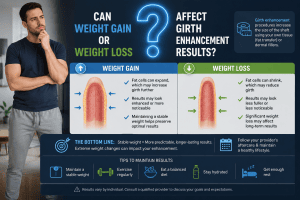
It’s a question that comes up in consultations more often than you might think — and the honest answer is: yes, body weight changes can affect your results. But the mechanism is more specific than most people assume.
The relationship between weight changes and girth enhancement is real but nuanced. It’s not as simple as “more weight means better results” or “losing weight erases everything you did.” The specific effects depend on the direction and magnitude of weight change, the type of enhancement performed, and the timeline relative to when the treatment was done.
This post covers the actual mechanisms involved, so you can make informed decisions about both the timing of your procedure and how to manage your results over time.
The Basic Anatomy Question: Does Weight Affect Penile Girth?
Before getting into how weight changes affect filler specifically, it helps to understand the baseline anatomy. Penile tissue itself doesn’t store fat in the way that abdominal, thigh, or chest tissue does. The penis is not primarily composed of adipose (fat) tissue, which means it doesn’t grow and shrink with weight in the same direct way that, say, your waist circumference does.
What does change with body weight is the suprapubic fat pad — the fatty tissue at the base of the pubic region, immediately above and around the base of the penis. In men who carry significant excess weight, this fat pad can partially obscure the base of the penis, creating the appearance of reduced penile length and, to some degree, girth. This is a well-documented phenomenon: significant weight loss in overweight or obese men often improves the visible appearance of genital dimensions because the obscuring fat pad reduces.
This baseline context matters for understanding the filler discussion, because it means weight change has two distinct potential effects: one on the tissue quality and characteristics that affect how the filler sits and integrates, and another on the overall visual appearance that comes from changes in the surrounding body composition.
“Weight changes don’t directly affect the filler the way you might expect. What they affect is the tissue environment the filler lives in — and the visual context around it.”
How Weight Gain Can Affect Girth Enhancement Results
Significant weight gain after girth enhancement has a few potential effects that are worth understanding.
The Suprapubic Fat Effect
As described above, weight gain that deposits fat in the suprapubic area can visually reduce the apparent length of the penis. For men who have had girth enhancement, this same fat deposition can also create a visual context that makes the enhancement appear less distinct — the increased surrounding tissue mass can somewhat absorb the visual impact of the added girth. This isn’t the filler disappearing; it’s the visual relationship between the enhancement and the surrounding body changing.
Tissue Laxity Changes
Significant weight gain stretches skin and underlying tissue over time. For penile tissue that is already somewhat distended by filler material, substantial weight gain that further increases tissue laxity could theoretically affect how the filler maintains its position and shape. This is a smaller concern than the suprapubic fat effect, and it’s primarily relevant in the case of very significant weight changes rather than the normal fluctuations of everyday life.
The Metabolic Rate Connection
There’s an indirect relationship between body composition and filler longevity that operates through metabolic rate. Higher body fat percentage is generally associated with lower resting metabolic rate relative to lean mass. Since hyaluronic acid filler is metabolized by enzymatic processes whose rate is partly influenced by overall metabolism, men with higher body fat percentages may find that filler longevity is somewhat extended relative to leaner individuals with the same treatment volume. This is a modest effect and shouldn’t be the basis for weight management decisions — but it is a real mechanism worth understanding.
How Weight Loss Can Affect Girth Enhancement Results
Weight loss effects on girth enhancement operate through several mechanisms, and this is where the nuance is most important to get right.
The Positive Visual Effect
For men who are overweight or obese at the time of their procedure, significant weight loss — particularly loss that reduces the suprapubic fat pad — can actually improve the visible impact of the girth enhancement by reducing the surrounding tissue that was obscuring or contextually minimizing the result. Weight loss, in this scenario, is additive to the enhancement rather than subtractive from it. The filler result becomes more visible, not less, as the surrounding body composition improves.
This is worth emphasizing because the intuitive assumption is often that weight loss reduces everything — but penile tissue, as noted, isn’t primarily fatty tissue, and the enhancement result doesn’t shrink with fat reduction in the way that abdominal circumference does.
The Tissue Laxity Concern
Rapid or very significant weight loss can reduce skin elasticity and create tissue laxity in some areas as the skin contracts to accommodate the reduced volume. For penile tissue specifically, the anatomy provides some protection against this concern — the extensible, mobile nature of penile skin means it accommodates volume changes more readily than, say, abdominal skin. But very significant weight loss achieved rapidly is a context where a consultation with your provider to assess the current state of tissue and filler is worth having, particularly if the results appear different than before the weight loss.
The Metabolic Acceleration Effect
Significant weight loss, particularly when accompanied by increased physical activity, tends to elevate resting metabolic rate and overall metabolic activity. Since HA filler is metabolized enzymatically, a meaningfully increased metabolic rate after substantial weight loss may accelerate filler metabolism, potentially shortening the effective duration of results. This is one reason that maintenance planning should account for significant planned weight loss rather than assuming the same maintenance interval will apply post-weight-loss as it did at a higher body weight.
Timing Considerations: Weight Before vs. After Enhancement
This brings up the practical question of timing: when is the right weight to get girth enhancement if your weight is actively changing?
The clinical guidance consistently points toward achieving a stable weight before undergoing any elective enhancement procedure. The reason is straightforward: a treatment calibrated to a body in flux is being optimized for a moving target. The tissue environment, the visual context, and the relationship between the enhancement and the surrounding body are all changing — which makes accurate result assessment and appropriate volume calibration significantly harder.
For men who are actively losing weight with a clear goal in mind, waiting until that goal is reached or closely approached before scheduling enhancement allows for treatment that is calibrated to your actual, stable body composition. It also means the visual improvement from the weight loss and the visual improvement from the enhancement are both present simultaneously, which often produces the most satisfying outcome.
For men considering enhancement who are at a stable weight they don’t plan to change significantly, the weight variable is less relevant and the standard clinical assessment process applies.
What This Means for Long-Term Enhancement Maintenance
Treatment longevity and the maintenance schedule for girth enhancement are influenced by the sum of factors that affect filler metabolism — and body weight and composition are among those factors. The most honest answer about how to plan for maintenance is that the first treatment cycle is the most informative data point for your personal situation. How the filler holds over your specific metabolism, tissue type, and activity level tells you more than any general guideline can.
What this means practically: if you’ve had significant weight changes between your procedure and your current state, communicate this to your provider at your follow-up visit. The maintenance interval that was appropriate for your body composition at the time of the procedure may need adjustment based on where you are now.
For men in the Garland, Texas area exploring enhancement options, the penis enhancement services in Garland are available with the kind of individualized consultation that accounts for all of these body composition and maintenance factors. And for the full overview of what the practice offers and how the process works, the girth enlargement clinic is the starting point.
Frequently Asked Questions
Does weight loss after girth enhancement reduce the results?
Not directly. Penile tissue is not primarily composed of fat, so weight loss doesn’t reduce penile girth the way it reduces waist circumference. For men who lose weight from an overweight baseline, the reduction in the suprapubic fat pad (the fatty tissue above and around the base of the penis) can actually improve the visible appearance of the enhancement by reducing the surrounding tissue that was partially obscuring it. Very rapid or very significant weight loss may affect tissue laxity and metabolic rate in ways that influence the filler environment, but these are secondary effects rather than the primary concern.
Should I lose weight before or after girth enhancement?
Before, for several reasons. Treatment calibrated to a stable body composition produces more predictable and satisfying results than treatment calibrated to a body that is actively changing. The visual result of the enhancement and the visual improvement from weight loss are both present simultaneously when weight loss is completed first. And the maintenance interval planning is more accurate when the metabolic rate associated with the post-weight-loss body is the baseline rather than a moving target. If you have a significant planned weight loss, completing it before scheduling enhancement is the generally recommended approach.
Does weight gain after enhancement affect how long the filler lasts?
Potentially, in a modest way. Men with higher body fat percentages tend to have somewhat lower resting metabolic rates per unit of body weight, which may slightly extend filler longevity compared to leaner individuals. This is a real but modest mechanism and should not be the basis for any weight management decision. The effect of significant weight gain on the tissue environment and visual context is more practically relevant than the metabolic effect on longevity, and neither should be interpreted as a reason to allow weight to increase after enhancement.
Can the suprapubic fat pad be reduced to improve the appearance of girth enhancement results?
Yes. The suprapubic fat pad is fat tissue that responds to overall body fat reduction — it doesn’t respond to spot treatment or targeted exercises more than other body fat does, but it does reduce proportionally with general weight loss. For men who are overweight and have had girth enhancement, meaningful weight loss that reduces the suprapubic fat pad improves the visible impact of the enhancement by creating a cleaner visual relationship between the enhancement and the surrounding tissue. This is one of the reasons that weight management is worth discussing in the context of enhancement goals rather than treating them as entirely separate matters.
How much weight change would significantly affect girth enhancement results?
Modest weight fluctuations of 5 to 15 pounds — the kind of normal variation most people experience over months — are unlikely to produce noticeable effects on girth enhancement results. The mechanisms described in this post are primarily relevant to significant weight changes: major weight loss (30+ pounds), substantial weight gain (20+ pounds), or changes associated with significant body composition shifts (e.g., going from obese to normal BMI, or from lean to significantly overweight). Normal life weight variation shouldn’t require changes to enhancement maintenance planning, but significant intentional weight changes are worth discussing with your provider as part of ongoing management.
Does exercise and increased muscle mass affect girth enhancement?
Increased physical activity, particularly resistance training that builds lean muscle mass, tends to elevate resting metabolic rate. As discussed, higher metabolic rate may somewhat accelerate HA filler metabolism, potentially shortening the maintenance interval. This is a real but modest effect and should not discourage physical fitness — the general health benefits of exercise far outweigh any modest effect on filler longevity, and the overall improvement in body composition that comes with regular exercise typically improves the visual context of girth enhancement rather than detracting from it. Discussing your activity level honestly with your provider during consultation allows for maintenance planning that accounts for this factor.