
Most conversations about girth enhancement focus on the procedure and the product. Fewer focus on the tissue that has to accept, support, and adapt to the enhancement — and that’s the part that actually shapes your outcome.
Understanding skin elasticity and girth enhancement isn’t just academic. It has practical implications for how you prepare for a procedure, what expectations are realistic for your specific situation, and what you can actually do to support better outcomes. This post covers the biology involved and the practical application of that biology.
What Skin Elasticity Actually Is
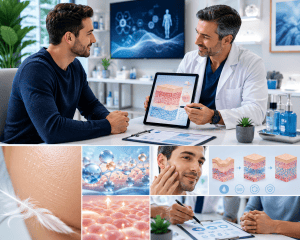
Skin elasticity refers to the skin’s ability to stretch and return to its original form. This property depends on two primary structural proteins: collagen and elastin. Collagen provides tensile strength — the structural framework that gives skin its form and resistance. Elastin provides the recoil — the snap-back quality that allows stretched skin to return to baseline.
The balance and health of these two proteins determine how skin behaves when subjected to volume changes. Highly elastic skin distributes volume additions smoothly, accommodates filler naturally, and maintains shape with good definition. Less elastic skin — whether due to age, lifestyle factors, or prior damage — responds differently, and the difference shows in the quality of the result.
For girth enhancement specifically, the penile skin’s elasticity is particularly relevant because this tissue is anatomically designed to accommodate significant volume changes during normal function. That design — the loose, extensible skin architecture — means that well-maintained penile tissue is often more suitable for enhancement procedures than other body regions. But this advantage depends on the health and condition of that tissue.
“The procedure creates the volume. The tissue has to do the work of making that volume look and feel natural. That’s a collaboration, not a one-way intervention.”
How Tissue Elasticity Affects Filler Support
The relationship between tissue elasticity and filler support is one of the more important and underexplained aspects of girth enhancement outcomes. Here’s what’s happening at a biological level.
When hyaluronic acid filler is placed in the tissue, it occupies volume and the surrounding tissue must accommodate that volume. In highly elastic tissue, this accommodation happens smoothly — the filler distributes evenly, the overlying skin drapes naturally over the added volume, and the result has the uniform, natural character that good enhancement outcomes require.
In tissue with reduced elasticity, the accommodation is less smooth. The filler may concentrate in areas of less resistance, creating uneven distribution. The overlying skin may not drape uniformly over the added volume. And the structural support that the tissue provides to the filler — the mechanical scaffolding that helps maintain the result’s shape over time — is weaker, which can contribute to faster migration or settling of the material.
This is why experienced providers assess tissue quality before determining treatment volume and technique. The same volume that produces an excellent result in one patient may require adjustment in a patient with different tissue characteristics. Providers who apply uniform treatment parameters regardless of tissue assessment are not practicing the level of individualization that produces consistently good outcomes.
Collagen Production and Its Role in Outcomes
Collagen production is the ongoing biological process that maintains the structural integrity of skin over time. As we age, collagen production declines — typically at a rate of about 1% per year after age 25. The practical effects of this decline are visible in skin that loses firmness, develops fine lines, and becomes more susceptible to sagging and structural irregularity.
For girth enhancement, declining collagen production means that the structural scaffolding the filler depends on for optimal support and shape maintenance is gradually weakening. This doesn’t preclude successful outcomes — but it means treatment parameters, volume selection, and maintenance planning should account for tissue age.
What Supports Collagen Production
The good news is that collagen production is influenceable through lifestyle factors. The most evidence-backed approaches include adequate dietary protein (collagen is a structural protein and requires amino acid building blocks that dietary protein provides), vitamin C (an essential cofactor for collagen synthesis), zinc (plays a role in the enzymatic processes of collagen production), and the avoidance of smoking — which significantly impairs both collagen synthesis and elastin integrity.
Sun exposure over time degrades collagen through UV-induced matrix metalloproteinase activity. Hydration supports the full-body tissue environment in which collagen functions. These aren’t miracle interventions, but the cumulative effect of consistent healthy lifestyle on tissue quality is real and documentable.
Penile Skin Health: The Specific Considerations
Penile skin health has characteristics specific to this anatomical site that affect enhancement outcomes. The skin here is thinner than most body sites, more vascularized, and structurally designed for accommodation rather than resistance. Understanding these characteristics helps explain both why this tissue generally responds well to carefully placed filler and what conditions diminish that responsiveness.
The Effect of Prior Procedures
Men who have had prior enhancement procedures present tissue that has been through one or more cycles of volume addition and partial metabolism. Scar tissue or fibrous changes from prior procedures can alter the distribution characteristics of new filler, sometimes creating areas of more or less resistance. This isn’t necessarily a barrier to good outcomes, but it is a tissue characteristic that an experienced provider needs to assess and account for in treatment planning.
Patients with prior procedure history benefit from full disclosure of that history at consultation, including what was done, when, and what the outcomes were over time. This information allows the provider to assess the current tissue state accurately rather than making assumptions based on visual assessment alone.
Hydration’s Specific Role
Hyaluronic acid is hydrophilic — it binds water and maintains volume partly through this mechanism. In well-hydrated tissue, filler integrates more fully and behaves more predictably. In dehydrated tissue, the relationship between filler and surrounding tissue is less optimal. This is one of the physiological bases for the consistent hydration guidance that appears in post-procedure care instructions for HA-based procedures — it’s not general wellness advice, it’s mechanistically relevant to the result.
What Patients Can Do to Support Better Tissue Quality
The practical takeaway from understanding tissue elasticity is that the period before and after the procedure is an opportunity to influence the tissue environment in which the enhancement will exist. These are not dramatic interventions — they’re basic tissue support measures that compound over time.
In the weeks before a procedure, prioritizing hydration, adequate dietary protein, and vitamin C intake supports the collagen and tissue health baseline. Avoiding smoking in the pre- and post-procedure period removes one of the most significant known impairments to tissue healing and collagen function. Getting adequate sleep — when tissue repair and regeneration is most active — is not incidental. These are the lifestyle factors that don’t make for exciting pre-procedure advice but actually matter to the tissue environment you’re presenting for treatment.
Post-procedure, the same factors apply, with the addition of following the specific recovery guidelines the provider gives you. Hydration supports HA filler function. Avoiding heat, friction, and elevated blood flow during the healing window protects the tissue while it’s doing its integrative work. Patients who treat recovery guidelines as optional are essentialy accepting a less optimized version of their result.
What the Assessment Should Look Like
A provider who is serious about enhancement results will assess tissue quality as part of the consultation process — not just proceed to treatment volume discussions without evaluating the substrate the treatment will be placed in. This assessment includes examining skin texture and tone, assessing the degree of existing skin laxity, identifying any prior procedure changes in the tissue, and factoring all of this into treatment volume and technique selection.
The detail and care of that assessment is one of the most reliable quality signals available when evaluating a provider. Providers who skip directly to volume discussion without tissue assessment are providing less individualized care than the outcomes require.
For patients who want to understand how this kind of individualized tissue assessment fits into the full treatment approach, the full treatment process and consultation methodology covers what a properly conducted evaluation involves and what patients should expect from each stage. And for anyone ready to have that consultation, the girth enlargement clinic is where that process begins.
Frequently Asked Questions
How does skin elasticity affect the look of girth enhancement results?
Highly elastic tissue accommodates filler volume smoothly, allowing the material to distribute evenly and the overlying skin to drape naturally over the added volume. This produces a result that looks and feels natural and uniform. Less elastic tissue responds less smoothly — filler may distribute unevenly, the skin may not accommodate the added volume with the same uniform coverage, and the structural support the tissue provides to maintain the result’s shape over time is weaker. The degree of elasticity in the tissue being treated is one of the primary factors that distinguishes excellent outcomes from average ones in otherwise similar treatment scenarios.
Can I improve my skin elasticity before a girth enhancement procedure?
Yes, within realistic limits for the timeframe. The most evidence-supported approaches include consistent hydration (HA filler is hydrophilic and functions better in well-hydrated tissue), adequate dietary protein and vitamin C (both support collagen synthesis), adequate sleep (when tissue repair is most active), and stopping smoking if applicable (smoking significantly impairs both collagen synthesis and elastin integrity). These measures won’t reverse years of tissue change in a few weeks, but they can meaningfully improve the baseline tissue environment the procedure has to work with.
Does age significantly affect girth enhancement outcomes through tissue changes?
Age is a factor in tissue quality through its effect on collagen production (which declines approximately 1% per year after age 25) and elastin integrity. These changes are gradual and cumulative rather than sudden, meaning the tissue quality difference between a 35-year-old and a 55-year-old is meaningful but not necessarily prohibitive to good outcomes. The appropriate response is adjusted volume selection, technique calibration, and maintenance planning — not a conclusion that older patients are poor candidates. Providers who adjust treatment parameters based on tissue assessment produce better outcomes across all age groups.
How do prior enhancement procedures affect tissue elasticity?
Prior procedures can create fibrous or scar tissue changes that alter the distribution characteristics of new filler — creating areas of more or less resistance that affect how material distributes. Multiple prior procedures may also create cumulative tissue changes that require more careful technique calibration. None of this necessarily prevents good outcomes from subsequent procedures, but prior procedure history is clinically relevant information that should be disclosed fully in the consultation. Providers who can assess and work with treated tissue effectively produce better outcomes in patients with prior history than those who treat it identically to baseline tissue.
Does smoking really affect enhancement outcomes through tissue quality?
Yes, significantly. Smoking impairs collagen synthesis through multiple mechanisms — it reduces oxygen delivery to tissue (collagen synthesis is oxygen-dependent), promotes the activity of enzymes that degrade existing collagen, and impairs vascular function in ways that affect the entire tissue environment. The effect on elastin is similarly negative. For girth enhancement, smoking is one of the most modifiable factors that negatively affects tissue quality. Patients who stop smoking in the pre-procedure period and maintain that cessation through recovery see measurably better tissue healing and result quality than those who continue. Most providers recommend stopping smoking at least two to four weeks before the procedure.
What should I expect from the tissue assessment during a girth enhancement consultation?
A thorough tissue assessment involves visual and tactile examination of skin texture and tone, assessment of existing skin laxity and elasticity, examination of overall structural tissue quality, identification of any prior procedure changes, and consideration of how these factors should influence treatment volume and technique. The assessment informs the treatment plan rather than simply confirming that treatment is possible. Consultations that skip directly to volume discussion without this assessment provide less individualized care than the outcomes warrant. The presence of a thoughtful tissue assessment is one of the most reliable signals that a provider is approaching treatment with the care the procedure requires.